
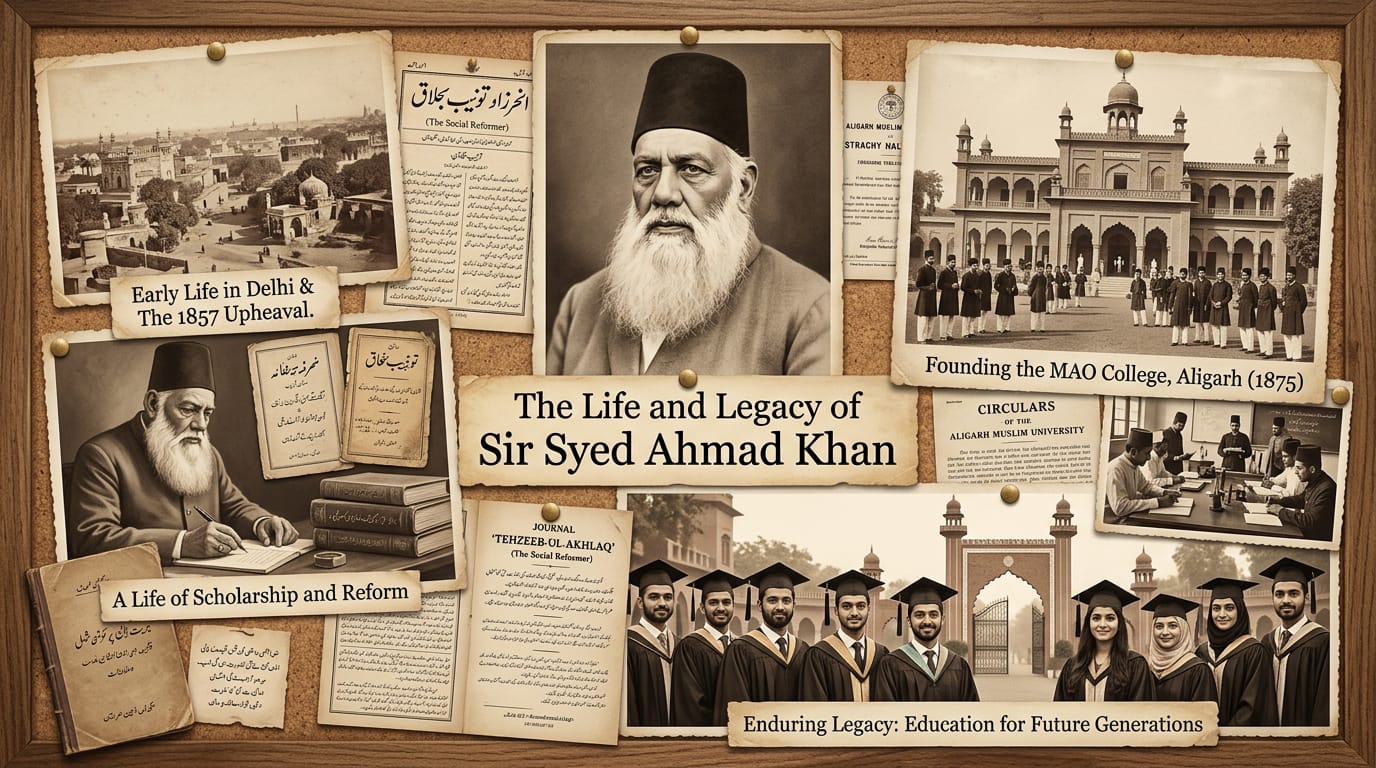
The Life and Legacy of Sir Syed Ahmad Khan
Introduction
Sir Syed Ahmad Khan was one of the most influential reformers in the history of the Indian subcontinent. He played a vital role in uplifting the Muslim community during a time of political, social, and educational decline. Through his vision, dedication, and modern approach, he laid the foundation for educational reform that continues to impact millions even today. His life is a powerful example of leadership, wisdom, and the importance of adapting to changing times.
Early Life and Background
Sir Syed Ahmad Khan was born on October 17, 1817, in Delhi, during the declining years of the Mughal Empire. He belonged to a respected family with strong ties to the royal court. Growing up in a scholarly environment, he received education in traditional subjects such as Arabic, Persian, and Islamic studies. However, he also showed a keen interest in modern knowledge and scientific thinking from an early age.
Despite facing financial difficulties after the fall of the Mughal Empire, Sir Syed remained determined to pursue knowledge and serve his community. His early experiences shaped his thinking and motivated him to bring positive change.
Role During the 1857 War
The Indian Rebellion of 1857 was a turning point in Sir Syed’s life. During this period, relations between Muslims and the British government became tense. Sir Syed worked to maintain peace and even helped protect British lives, which earned him recognition.
After the war, he wrote a famous book explaining the causes of the rebellion. In it, he argued that misunderstandings and lack of communication between the British and Indians led to the conflict. His efforts aimed to bridge the gap and reduce hostility.
Educational Reforms and Vision
Sir Syed Ahmad Khan strongly believed that education was the key to progress. At a time when many Muslims were hesitant to adopt Western education, he encouraged them to learn modern sciences, English language, and new ideas.
He founded the Aligarh Movement, which aimed to modernize Muslim education and thinking. His goal was to create a generation that could compete with others in education and government jobs.
In 1875, he established the Muhammadan Anglo-Oriental College, which later became Aligarh Muslim University. This institution combined Islamic teachings with Western education and became a center of excellence.
Social and Religious Contributions
Sir Syed was not only an educationist but also a social reformer. He worked to remove misconceptions about Islam and promote a modern interpretation of religion. He emphasized that Islam is compatible with science and reason.
Through his writings and speeches, he encouraged Muslims to leave outdated traditions and embrace progress. He also promoted unity, tolerance, and mutual respect among different communities.
His journal, Tahzeeb-ul-Akhlaq, played a major role in spreading awareness and reforming society. It focused on moral values, education, and social development.
Sir Syed Ahmad Khan faced strong opposition from conservative sections of society. Many people criticized him for promoting Western education and modern ideas. Some even accused him of weakening traditional Islamic values.
However, Sir Syed remained firm in his mission. He believed that without modern education, Muslims would fall further behind in society. His determination and courage helped him overcome these challenges and continue his work.
Legacy and Impact
The legacy of Sir Syed Ahmad Khan is immense and long-lasting. His efforts led to the educational awakening of Muslims in the subcontinent. The Aligarh Movement produced many leaders, scholars, and professionals who played important roles in society.
His vision also influenced future movements, including the struggle for independence and the creation of Pakistan. Many leaders were inspired by his ideas of education, unity, and progress.
Today, Aligarh Muslim University stands as a symbol of his vision and dedication. His contributions are remembered not only in India but also in Pakistan and across the Muslim world.
Conclusion
Sir Syed Ahmad Khan was a true visionary who understood the importance of education, reform, and unity. At a time of crisis, he guided his community towards progress and enlightenment. His life teaches us that change is possible through knowledge, determination, and strong leadership.
His legacy continues to inspire generations to seek education, embrace modernity, and work for the betterment of society. Sir Syed Ahmad Khan will always be remembered as a pioneer of reform and a champion of education.