
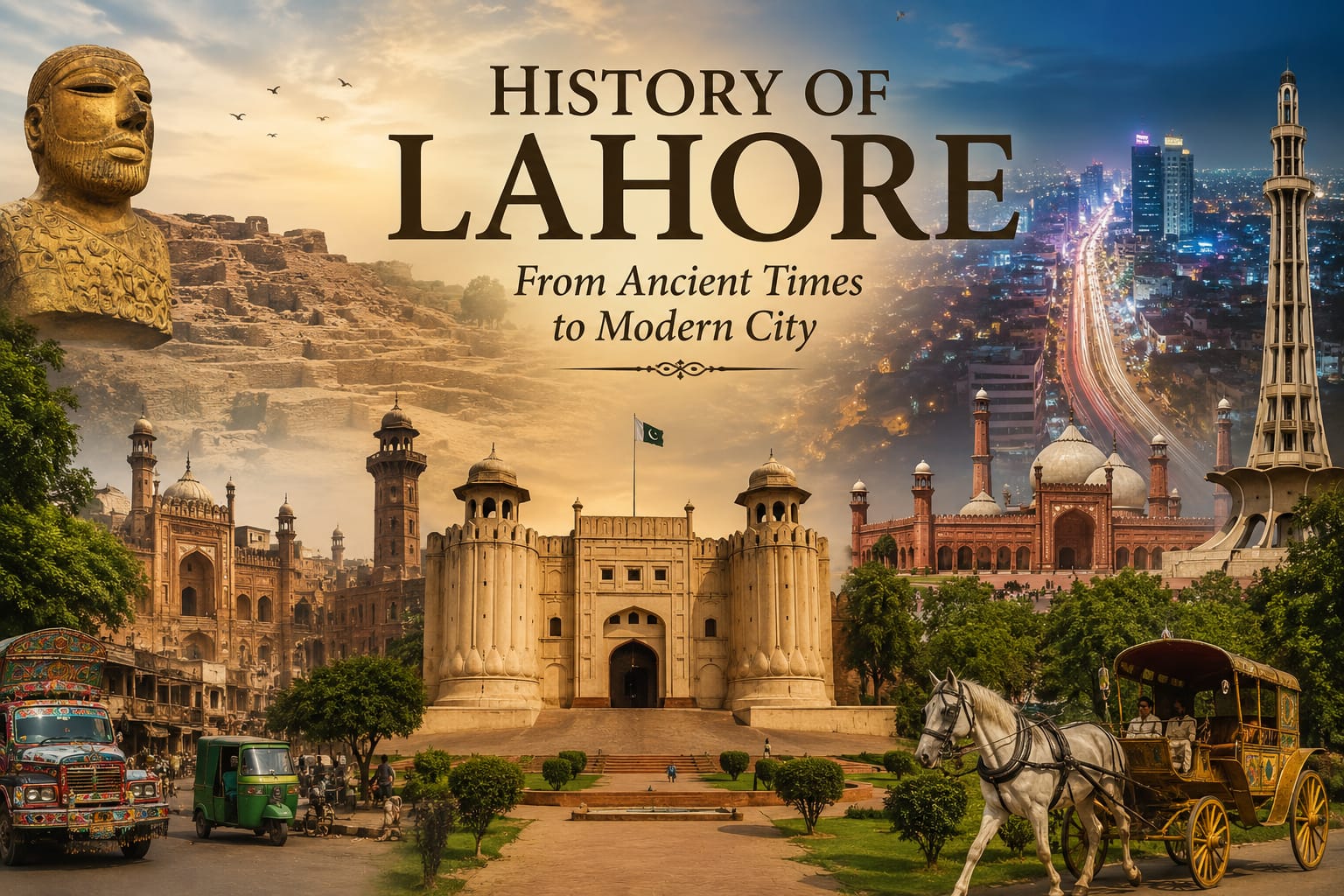
History of Lahore: From Ancient Times to Modern City
Lahore is more than just the cultural heart of Pakistan. It is a city where ancient history, Mughal architecture, colonial influences, and modern urban life exist side by side. From the narrow streets of the old city to the busy roads and modern neighborhoods, Lahore has changed dramatically over centuries while preserving much of its historical identity.
The history of Lahore is filled with stories of powerful rulers, magnificent buildings, changing empires, literature, art, education, and cultural traditions. Today, Lahore is one of Pakistan’s most important cities, but its roots go far deeper than the modern nation itself.
Ancient Origins of Lahore
The exact origins of Lahore remain uncertain, and historians have different views about how the city received its name. One traditional story connects Lahore with Lava, the son of the Hindu deity Rama. Another tradition associates the city’s name with an ancient settlement known as Lavapuri.
Although legends surround its earliest beginnings, Lahore’s location made it naturally important. Situated near the Ravi River and connected with important routes of the Punjab region, the city was well positioned for trade, travel, and political activity.
Over time, Lahore became part of different kingdoms and cultural spheres. Its strategic position meant that control over the city could provide access to the wider Punjab region.
Lahore During the Medieval Period
During the medieval period, Lahore became increasingly significant under Muslim rule. The city was influenced by several dynasties, and its political importance continued to grow.
The Ghaznavid period is particularly important in Lahore’s history. Mahmud of Ghazni’s campaigns brought parts of the region under Ghaznavid influence, and Lahore later became an important center of the Ghaznavid state in the Indian subcontinent.
One of the most famous rulers associated with Lahore was Sultan Mahmud’s successor, Mas’ud, although the city’s importance continued through several generations of rulers.
Lahore later came under the influence of the Delhi Sultanate. During these centuries, the city developed as a center of administration, commerce, scholarship, and Islamic culture.
Lahore Under the Mughal Empire
The Mughal era is arguably the most celebrated chapter in the history of Lahore. Mughal emperors transformed the city with gardens, mosques, palaces, walls, and monumental buildings.
Emperor Akbar expanded Lahore Fort and strengthened the city’s defenses. Lahore became one of the important imperial cities of the Mughal Empire, and for a period it served as an imperial capital.
The city’s architecture reached remarkable heights during the reigns of Akbar, Jahangir, Shah Jahan, and Aurangzeb.
Lahore Fort
The Lahore Fort is one of the city’s most important historical landmarks. Although the site has earlier origins, the Mughal rulers greatly expanded and rebuilt it.
The fort contains impressive structures including palaces, halls, courtyards, and decorative gateways. Its architecture reflects the artistic traditions of the Mughal period.
Badshahi Mosque
The Badshahi Mosque was commissioned by Emperor Aurangzeb in the seventeenth century. Its enormous courtyard, grand domes, and red sandstone architecture made it one of the most recognizable landmarks of Lahore.
Even today, the mosque remains one of the city’s most visited historical sites.
Shalimar Gardens
The Shalimar Gardens, built during Shah Jahan’s reign, represent the Mughal love of landscaped gardens and water features. Terraces, fountains, trees, and decorative structures created a carefully planned royal environment.
These monuments are not simply tourist attractions. Together, they demonstrate how Lahore developed into an important center of Mughal art and architecture.
Lahore After the Mughal Era
Following the decline of Mughal authority, Lahore experienced political instability. Different powers competed for influence over Punjab.
Eventually, the city became an important center under the Sikh Empire led by Maharaja Ranjit Singh.
Ranjit Singh made Lahore the capital of his empire. During his rule, several existing buildings were restored or modified, while Sikh religious and cultural sites also developed.
The Samadhi of Ranjit Singh, located near the Lahore Fort and Badshahi Mosque, is a reminder of this period.
This era added another important layer to Lahore’s diverse cultural history.
Lahore During British Rule
In 1849, the British annexed Punjab, bringing Lahore under British control. The city then entered a new phase of development.
British rule introduced new administrative institutions, educational establishments, roads, railways, and architectural styles. Lahore’s famous Mall Road became an important part of the colonial city.
Several well-known institutions were established or expanded during this period, including Government College, Punjab University, and other educational and administrative institutions.
British architecture can still be seen in many parts of Lahore. Buildings from this period often combine European architectural ideas with elements inspired by local traditions.
Lahore and the Pakistan Movement
Lahore played a major role in the political history of South Asia.
One of the most important events took place in 1940, when the All-India Muslim League passed the famous Lahore Resolution at Minto Park, now known as Greater Iqbal Park.
The resolution became an important milestone in the political movement that eventually led to the creation of Pakistan in 1947.
Because of this connection, Lahore holds a special position in the political history of Pakistan.
Lahore After Independence
After Pakistan gained independence in 1947, Lahore became the capital of Punjab and developed rapidly.
The city experienced major population growth as people migrated to Lahore from different parts of the region. New residential areas, markets, educational institutions, hospitals, and industrial zones expanded the city beyond its historic boundaries.
At the same time, Lahore remained strongly connected to its cultural traditions.
The old city continued to be known for its bazaars, food streets, traditional crafts, historic mosques, and centuries-old neighborhoods.
Modern Lahore
Modern Lahore is a combination of history and rapid urban development.
Areas such as Gulberg, Model Town, Johar Town, DHA, and other expanding neighborhoods reflect the city’s modern side. Shopping centers, universities, technology companies, restaurants, and entertainment venues have transformed Lahore into a major metropolitan city.
Yet, the historic heart of Lahore remains extremely important.
Places such as Walled City of Lahore, Lahore Fort, Badshahi Mosque, Wazir Khan Mosque, Shalimar Gardens, and the old bazaars continue to attract visitors.
The city’s food culture is another major part of its identity. Traditional dishes, street food, sweets, and restaurants have helped Lahore earn a reputation as one of Pakistan’s great food destinations.
Lahore’s Cultural Importance
Lahore has played an important role in Urdu and Punjabi literature, music, education, theatre, art, and journalism.
The city has produced and attracted writers, poets, artists, academics, musicians, and political thinkers. Its universities and cultural institutions continue to contribute to Pakistan’s intellectual life.
This cultural diversity is one reason Lahore is often described as the cultural capital of Pakistan.
The history of Lahore is important because it shows how a city can continuously change without completely losing its identity.
Ancient traditions, medieval influences, Mughal architecture, Sikh heritage, British-era buildings, and modern Pakistani culture can all be found within the same city.
Walking through Lahore can therefore feel like moving through different chapters of history. A modern road may lead toward an old Mughal gate, while a centuries-old mosque may stand close to a busy modern market.
Conclusion
The history of Lahore is a story of transformation. From its uncertain ancient beginnings to its importance under Muslim dynasties, from the grandeur of the Mughal Empire to the Sikh and British periods, Lahore has repeatedly adapted to political and social change.
Today, it is a modern Pakistani metropolis, but its historic buildings, literature, food, traditions, and neighborhoods continue to connect the present with the past.
For anyone interested in Pakistan’s history, Lahore offers something unique: instead of simply reading about different historical periods, visitors can often see their traces within the same city.