
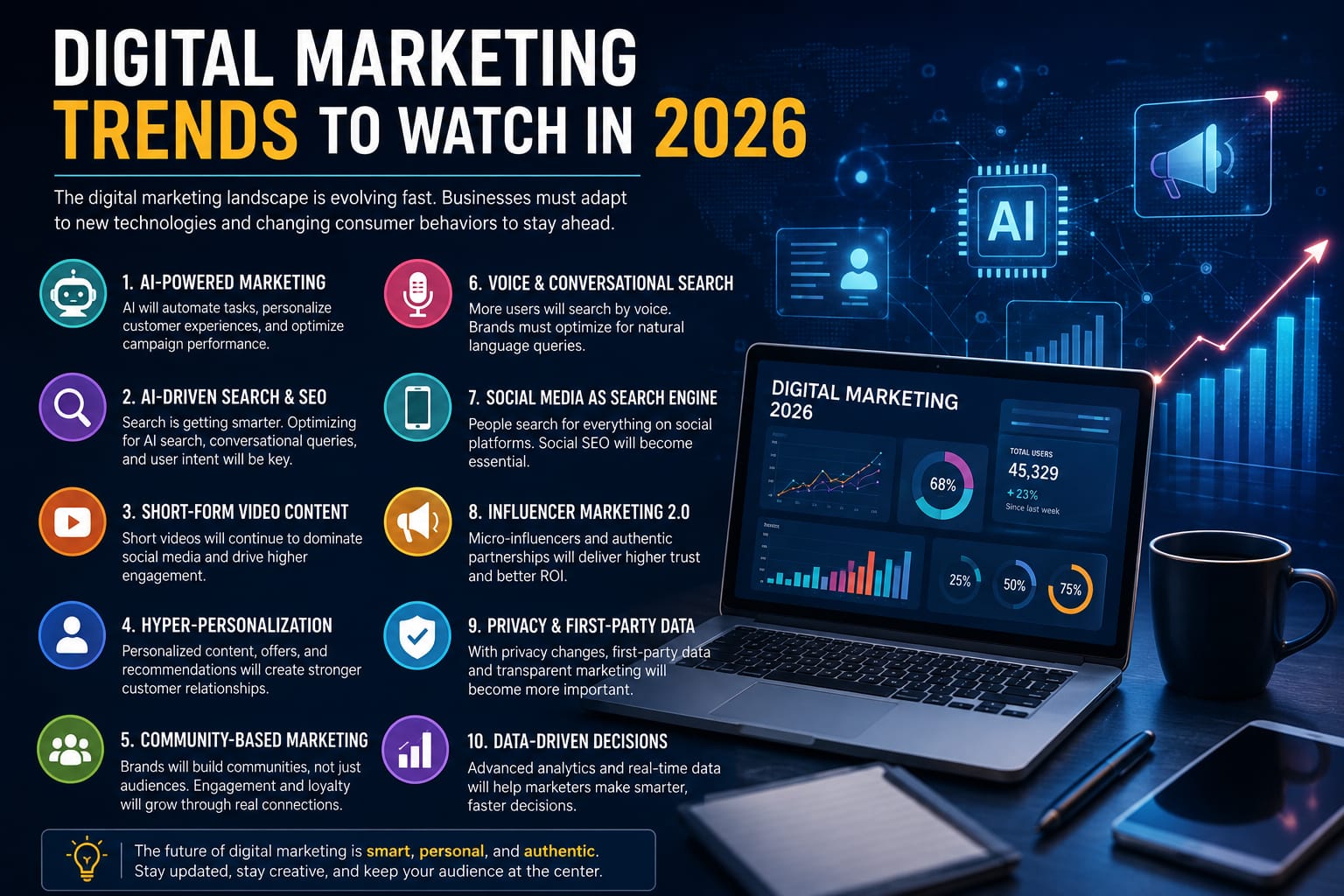
Digital Marketing Trends to Watch in 2026
Digital marketing is changing faster than ever. New technologies, changing consumer behavior, artificial intelligence, and evolving search engines are transforming the way businesses connect with their audiences. In 2026, simply posting content on social media or running traditional advertisements is no longer enough. Brands need smarter strategies, useful content, personalization, and a strong understanding of their customers.
For businesses, bloggers, freelancers, and content creators, keeping up with the latest digital marketing trends in 2026 can create new opportunities for growth. From AI-powered marketing to short-form video and conversational search, several trends are expected to shape the digital landscape this year.
In this article, we will explore the most important digital marketing trends to watch in 2026 and explain how businesses can use them effectively.
1. Artificial Intelligence in Digital Marketing
Artificial intelligence has become one of the biggest forces in digital marketing. In 2026, AI is being used for content planning, customer support, data analysis, advertising, and personalization.
AI tools can help marketers understand customer behavior and identify which content is more likely to perform well. Businesses can also use AI to generate ideas, analyze campaigns, create content drafts, and automate repetitive tasks.
However, successful marketers should not depend entirely on AI-generated content. Human creativity, experience, fact-checking, and originality remain important. The best strategy is to combine AI efficiency with human expertise.
2. AI-Powered Search and Changing SEO
Search behavior is evolving. People are increasingly using AI-powered search experiences to find answers instead of relying only on traditional search results.
This means SEO in 2026 is becoming more focused on helpful, accurate, original, and clearly structured content. Websites should answer real questions instead of creating articles only to target keywords.
Businesses should focus on:
– Clear and useful answers
– Original research and insights
– Strong topic coverage
– Natural keyword usage
– Easy-to-read formatting
– Reliable information
– Good website experience
The goal is no longer simply to rank for one keyword. Brands should aim to become a trustworthy source of information within their topic or industry.
3. Short-Form Video Marketing
Short-form videos continue to be an important part of digital marketing. Platforms such as TikTok, Instagram Reels, and YouTube Shorts allow brands to reach audiences quickly through entertaining and informative content.
Short videos can be used for product demonstrations, tutorials, behind-the-scenes content, customer stories, tips, and educational information.
The biggest advantage of short-form video is its ability to communicate an idea within seconds. Businesses that create useful and authentic videos can build awareness without requiring huge production budgets.
In 2026, brands should focus less on making every video look like an advertisement and more on creating content people genuinely want to watch.
4. Personalization Will Become More Important
Consumers are exposed to thousands of marketing messages every day. Generic advertisements and emails are therefore less likely to attract attention.
Personalized marketing allows businesses to provide more relevant experiences based on customer interests, previous interactions, and preferences.
For example, an online store can recommend products based on previous browsing behavior, while an email campaign can send different messages to different customer groups.
However, personalization should be balanced with privacy. Businesses need to use customer data responsibly and clearly communicate how information is collected and used.
5. Social Media Is Becoming a Search Engine
Social media platforms are no longer used only for entertainment. Many people now search social platforms for products, restaurants, reviews, tutorials, recommendations, and opinions.
This makes social media SEO an increasingly valuable strategy in 2026.
Businesses should optimize their social profiles and content by using relevant keywords, descriptive captions, useful hashtags, and clear titles. Creating content that directly answers common questions can also improve discoverability.
For example, a travel business could create videos such as “Best Places to Visit in Lahore” or “Things to Do in Karachi.” Such content can attract people who are actively searching for information.
6. Influencer Marketing Is Becoming More Authentic
Influencer marketing continues to evolve. Instead of focusing only on celebrities with millions of followers, brands are increasingly interested in creators with smaller but highly engaged communities.
Micro-influencers can have strong relationships with their audiences because their content often feels more personal and authentic.
In 2026, brands should look beyond follower counts and consider engagement, audience relevance, credibility, and content quality when selecting influencers.
A creator with 20,000 highly engaged followers may sometimes be more valuable to a niche business than a celebrity with millions of unrelated followers.
7. Voice and Conversational Search
People are increasingly using conversational language when interacting with digital assistants and AI tools. Instead of typing short keywords, users may ask complete questions.
This creates opportunities for businesses to optimize content around natural-language searches.
For example, instead of targeting only “digital marketing trends,” a website can also answer questions such as:
“What are the biggest digital marketing trends in 2026?”
Creating FAQ sections, detailed explanations, and conversational content can help businesses match the way people naturally search for information.
8. First-Party Data Will Matter More
Privacy changes are making first-party data increasingly valuable. First-party data is information that businesses collect directly from their own customers or audiences, such as newsletter subscriptions, website interactions, and customer preferences.
Instead of depending entirely on third-party platforms, businesses can build direct relationships with their audiences.
Email newsletters, loyalty programs, customer accounts, surveys, and website communities can help businesses develop these relationships.
The key is to provide value in exchange for information and handle customer data responsibly.
9. Interactive and User-Generated Content
Interactive content can make digital marketing more engaging. Quizzes, polls, calculators, surveys, interactive stories, and contests can encourage users to participate rather than simply consume information.
User-generated content is another powerful strategy. Reviews, customer photos, testimonials, and social media posts can provide authentic proof that a product or service is useful.
Consumers often trust real experiences more than traditional advertisements. Businesses can encourage satisfied customers to share their experiences and, with permission, feature that content in their marketing campaigns.
10. Content Quality Over Content Quantity
Publishing dozens of low-quality articles is not an effective long-term strategy. Search engines and audiences increasingly value useful, trustworthy, and original content.
In 2026, businesses should focus on creating fewer but stronger pieces of content.
A high-quality article should provide genuine value, answer the reader’s questions, use clear headings, include relevant examples, and avoid unnecessary repetition.
Content should also be updated when information becomes outdated. Regular content improvement can be just as important as publishing new articles.
11. Community-Based Marketing
Building a community can create stronger customer relationships than simply collecting followers.
Brands can use Facebook groups, Discord communities, newsletters, online forums, and other platforms to communicate directly with their audiences.
Community marketing allows businesses to understand customer problems, collect feedback, answer questions, and develop long-term loyalty.
Instead of asking only, “How can we sell this product?” marketers should also ask, “How can we help our audience?”
12. The Importance of Trust and Authenticity
Trust is becoming one of the most valuable assets in digital marketing. With the growing amount of AI-generated content online, audiences may become more selective about which sources they trust.
Brands can build credibility by showing real people, sharing genuin
e experiences, providing transparent information, and correcting mistakes when necessary.
Authenticity does not mean that every piece of content must be perfect. It means communicating honestly and consistently with the audience.
How Businesses Can Prepare for Digital Marketing in 2026
Following every trend is not necessary. Businesses should select strategies that match their goals and target audience.
A practical approach is to:
A practical approach is to:
1. Identify your target audience.
2. Understand what questions and problems they have.
3. Create useful and original content.
4. Use AI to improve efficiency, not replace human judgment.
5. Invest in short-form video where appropriate.
6. Optimize content for both traditional and conversational search.
7. Build an email list and direct audience relationships.
8. Monitor analytics and measure results.
9. Test different strategies instead of relying on assumptions.
10. Keep updating your marketing strategy as consumer behavior changes.