
Hidden Historical Places in Pakistan: Discover the Country’s Forgotten Heritage
Pakistan is often recognized for famous historical landmarks such as the Badshahi Mosque, Lahore Fort, Mohenjo-daro, and Taxila. However, beyond these well-known destinations lies another fascinating side of the country: hidden historical places in Pakistan that receive far less attention.
From ancient settlements and forgotten forts to historic towns and mysterious archaeological sites, these locations offer a deeper look into Pakistan’s rich cultural heritage. Some are difficult to reach, while others remain relatively unknown to tourists. Exploring them can reveal stories of ancient civilizations, powerful rulers, trade routes, religious traditions, and local communities.
From ancient settlements and forgotten forts to historic towns and mysterious archaeological sites, these locations offer a deeper look into Pakistan’s rich cultural heritage. Some are difficult to reach, while others remain relatively unknown to tourists. Exploring them can reveal stories of ancient civilizations, powerful rulers, trade routes, religious traditions, and local communities.
For history lovers and travelers looking for something different, these lesser-known historical places in Pakistan are worth discovering.
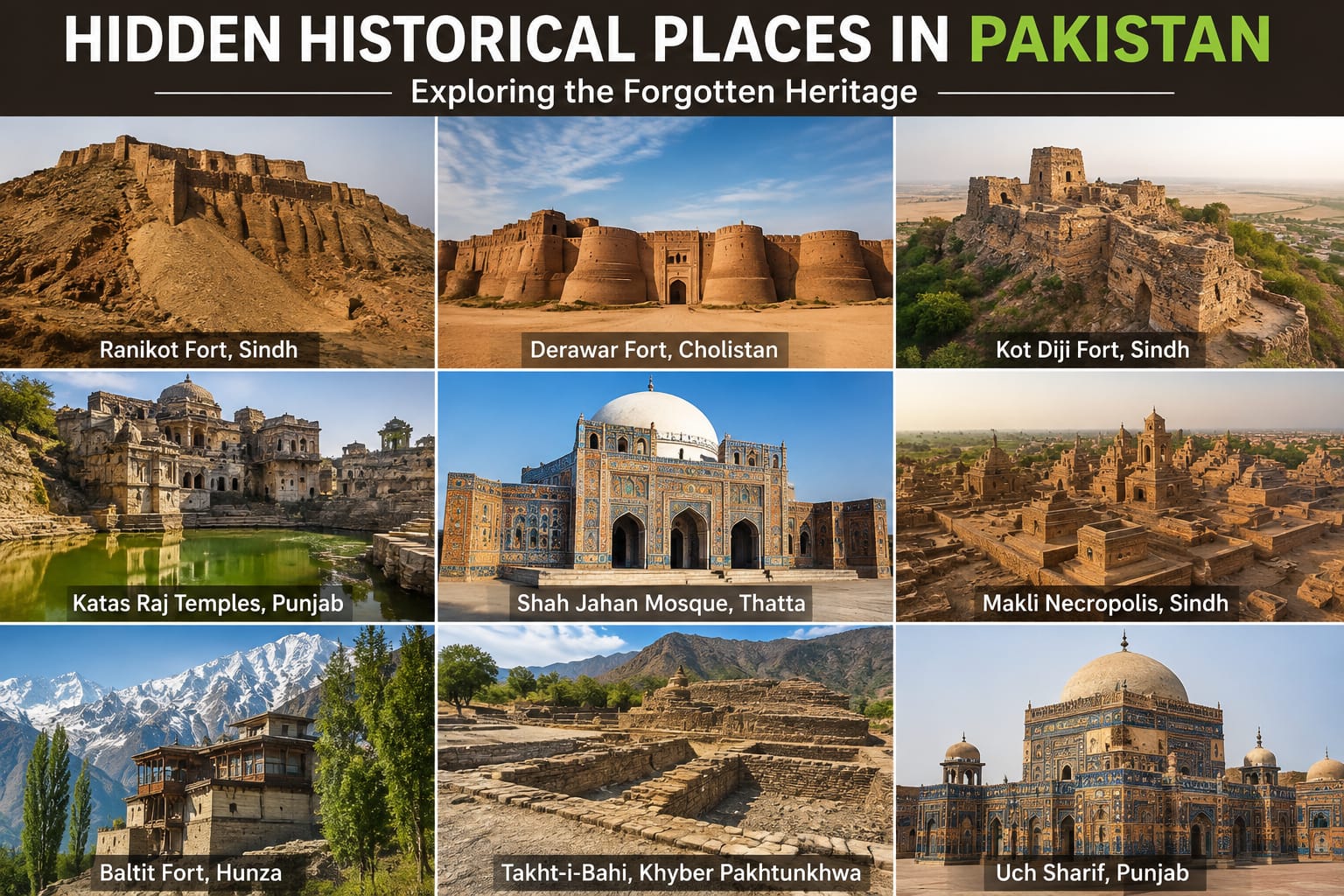
1. Ranikot Fort, Sindh
Often associated with the title “Great Wall of Sindh,” Ranikot Fort is one of the most impressive historical structures in Pakistan. Located in the Jamshoro District of Sindh, the fort stretches across a rugged landscape surrounded by hills.
Its enormous walls follow the natural contours of the terrain, creating a dramatic landscape. Although the exact origins and construction history of Ranikot remain debated, the site has enormous archaeological and historical importance.
Inside the larger fortification are additional structures and smaller fortified areas, including Mirikot and Shergarh. The remote location adds to the mysterious atmosphere of the site.
For travelers interested in ancient architecture and unexplored destinations, Ranikot Fort is a remarkable place to visit.
2. Kot Diji Fort, Sindh
Another fascinating historical site in Sindh is Kot Diji Fort, located near Khairpur. Built on a hill, the fort overlooks the surrounding landscape and represents an important period in the region’s history.
The area is also closely associated with the Kot Diji archaeological culture, which predates the mature Indus Valley Civilization. Archaeological discoveries from the region provide evidence of an ancient settlement and an organized society.
The fort itself reflects later military history, while the archaeological remains nearby connect visitors to a much older past.
This combination makes Kot Diji an especially interesting destination for people who want to explore different historical periods in one region.
3. Derawar Fort, Cholistan
Standing dramatically in the Cholistan Desert, Derawar Fort is one of Pakistan’s most recognizable desert landmarks, yet it is still less visited than many major tourist attractions.
The enormous square-shaped fortress features dozens of massive bastions that can be seen from a considerable distance across the desert.
Derawar was an important part of the region’s defensive and political history. Its location also reflects the importance of desert routes and settlements in the past.
The surrounding Cholistan region contains many historic sites, abandoned settlements, and old forts, making it an excellent destination for travelers interested in desert history.
4. Rohtas Fort’s Lesser-Known Surroundings
Rohtas Fort near Jhelum is relatively famous, but many visitors focus only on the main fort and overlook the historical landscape around it.
Built during the reign of Sher Shah Suri, Rohtas was designed as a powerful military stronghold. Its massive gates, walls, and defensive structures demonstrate the military engineering of the period.
Beyond the main tourist route, the surrounding region contains villages, old pathways, and historical features that provide additional insight into the fort’s strategic importance.
Exploring the wider area can help visitors understand why this location was selected and how it connected different parts of the region.
5. Katas Raj Temples, Punjab
The Katas Raj Temples, located in Chakwal District, are among the most culturally and historically significant religious sites in Pakistan.
The complex consists of several temples surrounding a sacred pond. The site is associated with Hindu traditions and has a long religious history.
Its architecture, legends, and surrounding landscape make it an important example of Pakistan’s diverse cultural heritage.
Katas Raj also demonstrates that the history of the region cannot be understood through one culture or period alone. Over centuries, different communities contributed to the cultural identity of the area.
6. Shah Jahan Mosque, Thatta
The Shah Jahan Mosque in Thatta is one of Sindh’s architectural treasures. Although the mosque is known among historians and architecture enthusiasts, it receives less international attention than some of Pakistan’s more famous monuments.
Exploring the wider area can help visitors understand why this location was selected and how it connected different parts of the region.
The Shah Jahan Mosque in Thatta is one of Sindh’s architectural treasures. Although the mosque is known among historians and architecture enthusiasts, it receives less international attention than some of Pakistan’s more famous monuments.
Built during the Mughal period, the mosque is particularly famous for its beautiful brickwork, geometric patterns, domes, and impressive acoustic design.
The building reflects the architectural traditions of Sindh while also showing influences associated with the wider Mughal world.
Thatta itself was once an important center of culture, learning, trade, and political activity. Visiting the mosque provides an opportunity to explore a much broader historical landscape.
7. Makli Necropolis, Sindh
Near Thatta lies Makli Necropolis, one of the world’s largest historical burial sites. Spread across a vast area, Makli contains thousands of graves and numerous decorated tombs.
ear Thatta lies Makli Necropolis, one of the world’s largest historical burial sites. Spread across a vast area, Makli contains thousands of graves and numerous decorated tombs.
The monuments represent several centuries of Sindhi history and include architectural influences from different periods.
Stone carvings, tile work, calligraphy, and intricate designs make many of the tombs remarkable examples of South Asian architecture.
Makli is especially valuable because it tells history through funerary architecture. The monuments provide clues about the political leaders, scholars, saints, and communities that shaped the region.
8. Baltit and Altit’s Ancient Heritage, Hunza
The Hunza Valley is famous for spectacular mountains, but its historic forts are equally important.
Altit Fort and Baltit Fort represent centuries of political and cultural history in the region. Their elevated locations provided strategic advantages while also allowing local rulers to oversee important routes.
The architecture reflects a mixture of local building traditions and influences from neighboring regions.
9. Takht-i-Bahi, Khyber Pakhtunkhwa
For those interested in ancient Buddhist heritage, Takht-i-Bahi is a remarkable historical site in Khyber Pakhtunkhwa.
The ruins are associated with an ancient Buddhist monastic complex and are located on a hill, helping preserve many of the structures.
The site provides evidence of the importance of Buddhism in the ancient Gandhara region. Visitors can explore remains of monastic areas, courtyards, meditation spaces, and other archaeological structures.
Takht-i-Bahi is particularly valuable for understanding the historical connection between South Asia and the wider Buddhist world.
10. Uch Sharif, Punjab
Uch Sharif is a historic town in southern Punjab known for its religious monuments, shrines, and distinctive architecture.
The town has played an important role in the history of Sufism in the region. Its historic tombs feature colorful tile work, decorative brickwork, and architectural styles that reflect centuries of cultural development.
One of the most notable structures is the tomb associated with Bibi Jawindi. The monument is recognized for its distinctive design and historical importance.
Uch Sharif is an excellentexample of a place where history, spirituality, architecture, and local traditions come together.
11. Mankiala Stupa, Punjab
Located near Rawalpindi, Mankiala Stupa is another lesser-known site connected with the Buddhist heritage of ancient Gandhara.
The stupa is believed to date to the Kushan period and represents the spread of Buddhist culture and architecture in the region.
Although it does not receive the same number of visitors as Pakistan’s most famous archaeological attractions, the site is valuable for anyone interested in ancient religious history.
Its relatively quiet surroundings also provide a different experience from crowded tourist destinations.
Why These Hidden Historical Places Matter
The lesser-known historical sites of Pakistan are important for more than tourism. They preserve evidence of civilizations, communities, religions, and political systems that existed across the region for centuries.
These locations can help researchers and visitors understand how different cultures interacted and how architecture changed over time.
They also have the potential to support local tourism. When visitors explore lesser-known destinations, nearby communities can benefit from tourism-related activities such as transportation, accommodation, food services, and local handicrafts.
However, responsible tourism is essential. Visitors should avoid damaging old structures, removing archaeological objects, writing on historic walls, or leaving waste behind.
Best Way to Explore Pakistan’s Historical Heritage
Travelers interested in historical places should research local conditions before planning a trip. Some archaeological sites are remote and may have limited facilities.
A responsible traveler should:
– Check local travel conditions before visiting.
– Follow site rules and instructions.
– Avoid touching or damaging ancient structures.
– Respect religious and cultural sites.
– Keep historical locations clean.
– Consider hiring a knowledgeable local guide.
– Support local businesses where possible.
– Take photographs without disturbing other visitors or worshippers.
These simple steps can help protect Pakistan’s heritage for future generations.
Conclusion
Pakistan’s history extends far beyond its most famous landmarks. From the massive walls of Ranikot and the desert towers of Derawar to the ancient Buddhist remains of Takht-i-Bahi and the historic tombs of Uch Sharif, the country contains countless stories waiting to be explored.
These hidden historical places in Pakistan demonstrate the extraordinary diversity of the region’s past. They connect visitors with ancient civilizations, Islamic architecture, Buddhist heritage, local kingdoms, Mughal traditions, and centuries of cultural exchange.
For anyone interested in history and travel, exploring these lesser-known destinations can be a rewarding experience. Preserving them is equally important, because every old fort, temple, tomb, mosque, and archaeological site represents a piece of Pakistan’s cultural story.