

Starting a small business in the USA does not always require thousands of dollars, a storefront, or a team of employees. Some businesses can be started with little more than a laptop, a useful skill, basic equipment, or resources you already have.
The key is choosing a business model that keeps your initial expenses low while giving you a realistic way to find paying customers. Your actual startup cost will depend on factors such as your location, equipment, insurance, transportation, business structure, and local licensing requirements.
If you are looking for a business you can start part-time, from home, or with a relatively small initial investment, here are eight options worth considering.
1. Freelance Writing and Content Services
Freelance writing is one of the simplest businesses to start if you already have strong writing and research skills. Businesses, nonprofits, agencies, online stores, and professionals regularly need website content, blog posts, newsletters, product descriptions, scripts, and editing.
The startup cost can be extremely low. If you already own a reliable computer and have internet access, your main expenses may be a portfolio website, domain, writing software, and basic marketing. A practical starting budget could be around $0–$300.
You can charge clients per project, hour, word, or through monthly packages. Over time, specializing in an area such as technology, finance, healthcare, or local business content can make it easier to stand out.
The challenge is not the equipment—it is finding reliable clients and building recurring work. The Bureau of Labor Statistics notes that many writers and authors are self-employed and can work from almost anywhere with computer access.
Best for: Students, skilled writers, freelancers, and people who want a remote business.
2. Virtual Assistant Services
Virtual assistants provide administrative support remotely. Depending on their skills and client agreements, they may manage calendars, organize emails, format documents, enter data, coordinate appointments, prepare spreadsheets, or handle basic customer follow-ups.
This business can be started with an existing computer, internet connection, office software, and communication tools. A reasonable planning budget is around $0–$300 if you already have the necessary technology.
Instead of working for one employer, a virtual assistant can serve several clients and charge hourly rates, monthly packages, or recurring retainers.
Organization and reliability are particularly important because clients may give virtual assistants access to sensitive business information. Written agreements should clearly explain responsibilities, access to accounts, working hours, payment terms, and confidentiality.
The BLS notes that administrative support roles commonly require familiarity with word-processing and spreadsheet software, making these skills useful foundations for a virtual assistant business.
Best for: Organized people, remote workers, students, freelancers, and beginners with good administrative skills.
3. Social Media Management
Many small businesses know they need a social media presence but do not have enough time to consistently create and schedule content. That creates an opportunity for freelance social media managers.
A beginner might offer services such as content calendars, captions, basic graphics, short-form videos, scheduling, community responses, and simple performance reports.
Startup costs can be relatively low—roughly $0–$500, depending on the computer or smartphone you already own and whether you use paid design, editing, or scheduling software.
Instead of trying to manage every platform for every type of business, beginners can start with a specific niche. For example, someone might focus on restaurants, fitness studios, real-estate professionals, or local retailers.
The biggest challenge is managing client expectations. Social media results are not completely predictable, and clients may expect rapid growth. A clear contract should define exactly what content and services are included.
Best for: Creative people who understand social platforms and want a flexible, part-time service business.
4. Cleaning Services
Cleaning services are less dependent on digital skills and can be started locally with basic equipment. Options include residential cleaning, apartment cleaning, move-in and move-out services, office cleaning, and specialized cleaning tasks.
A basic residential operation might require approximately $150–$800 to get started if you already have transportation and a vacuum. Commercial equipment, insurance, transportation, and specialized services can increase the cost.
The business model is straightforward: customers pay per visit, home, job, or recurring cleaning schedule. Building a base of weekly or biweekly customers can provide more predictable work than relying entirely on one-time jobs.
Cleaning is also relatively accessible from an education standpoint. BLS data places janitors and building cleaners among occupations that generally do not require a formal educational credential.
However, accessibility does not mean there are no requirements. Depending on your location and type of work, you may need business registration, insurance, or other local compliance measures. Safe handling of cleaning chemicals is also essential.
Best for: Beginners who prefer hands-on work and want to serve customers in their local area.
5. Pet Sitting and Dog Walking
If you enjoy working with animals, pet sitting and dog walking can be started without investing in a large amount of equipment.
A basic dog-walking service may need leashes, waste bags, a phone, scheduling tools, transportation, and basic safety supplies. A practical starting budget could be around $50–$400, although insurance, certifications, transportation, or overnight services can increase expenses.
You can charge customers per walk, visit, day, overnight stay, or through recurring packages. Potential customers include busy professionals, frequent travelers, older adults, and families who need help caring for their pets.
The business does come with responsibility. You may be handling animals with different temperaments or entering customers’ homes, so reliability and safety matter. Clear agreements should also cover emergency contacts and veterinary authorization.
The BLS projects strong growth for animal caretaker employment overall between 2025 and 2035, although that category includes many jobs beyond independent pet sitting and dog walking.
Best for: Students, animal lovers, side hustlers, and people looking for flexible local work.
6. Tutoring or Online Tutoring
Tutoring is another low-cost business where your knowledge can become the main product.
You can tutor school subjects, languages, writing, test preparation, study skills, computer skills, or other areas in which you have genuine expertise. Online tutoring can be especially inexpensive because you may only need a computer, internet connection, webcam, video-conferencing software, and digital teaching materials.
A practical starting budget can be around $0–$250 if you already have the necessary technology.
Tutors can charge per session, hour, package, or small-group class. Your target customers might include school students, college students, adult learners, or families looking for additional academic support.
The biggest challenge is establishing credibility. Qualifications, strong subject knowledge, testimonials, references, or a clearly defined specialty can help convince parents and students to choose you.
You should also clearly communicate cancellation policies, payment terms, and expectations before starting lessons. Requirements for operating a tutoring business can vary by location and situation.
Best for: Students, teachers, subject-matter experts, bilingual professionals, and people who enjoy teaching.
7. Mobile Car Detailing
Mobile car detailing takes a traditional service and brings it directly to the customer. Instead of requiring customers to visit a shop, you clean and detail their vehicles at a permitted location such as their home or workplace.
A basic setup might cost around $300–$1,500 if you already own a suitable vehicle. Equipment can include cleaning chemicals, microfiber towels, brushes, a vacuum or extractor, buckets, and other detailing tools. More advanced operations may require pressure washers, water tanks, generators, or higher-end equipment.
Customers can include commuters, families, rideshare drivers, used-car sellers, professionals, dealerships, and small vehicle fleets. Revenue can come from individual detailing packages, add-on services, or recurring fleet arrangements.
The advantage is that customers can see a noticeable before-and-after result, which can make referrals particularly valuable.
However, operating costs are higher than for digital businesses. Fuel, equipment maintenance, cleaning supplies, weather, water access, and transportation all affect profitability.
Local rules can also matter. Before operating, check requirements relating to business licensing, wastewater or runoff, parking, property permission, and insurance.
Best for: Hands-on entrepreneurs who already own a vehicle and want a local service business.
8. Home-Based Baking or Specialty Food Business
If you already have baking or food-production skills, a home-based food business can be an appealing way to start small.
You could sell permitted baked goods, specialty foods, preorder boxes, or products for local events and markets. Initial expenses might include ingredients, packaging, labels, food-safety requirements, and any necessary registration or permits.
A narrow home-baking operation might require around $150–$1,000 to get started, assuming you already have suitable kitchen equipment. However, costs can become much higher if your products require commercial kitchen facilities, refrigeration, specialized equipment, or additional inspections.
This is also the business idea on this list where regulations require the most attention. Cottage-food rules vary by state and can determine what foods you are allowed to make at home, where you can sell them, how products must be labeled, and whether registration or food-safety training is required.
For example, Penn State Extension notes that certain shelf-stable baked goods may qualify under limited food-production rules, while products such as cream pastries and other temperature-controlled foods can face additional requirements.
Best for: Skilled home bakers and food entrepreneurs willing to research their state’s requirements before selling.
How to Choose the Right Low-Cost Business
The cheapest business is not automatically the best business for you. A better approach is to consider what you already have: your skills, equipment, available time, transportation, and access to potential customers.
If you already have a laptop and strong communication skills, freelance writing, virtual assistance, social media management, or online tutoring can be among the easiest options to test.
If you prefer physical work and local customers, cleaning, dog walking, or pet sitting may be a better fit. If you own a suitable vehicle and are comfortable investing more in equipment, mobile car detailing could offer a more hands-on business model.
Home baking can also work well, but it should not be treated like an ordinary home-based side hustle. Food businesses are subject to state and local rules, so you should confirm what is legally permitted before purchasing equipment or advertising products.
A Simple Way to Start
You do not need to spend your entire budget before knowing whether customers actually want your service.
Start with one specific offer. Identify a narrow customer group, decide what you will provide, calculate your basic costs, and test the market. For example, instead of offering “social media management,” you could offer a small monthly content package specifically for local restaurants.
Keep records of your income and business expenses from day one. The IRS notes that self-employed individuals may have federal tax obligations, including filing requirements once applicable income thresholds are met.
The SBA also recommends considering startup expenses such as registration, permits, insurance, and other business costs before launching.
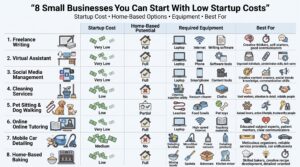
Startup Cost Comparison
Final Thoughts
Starting a small business in the USA with limited money is possible, but “low startup cost” does not mean “no cost” or “easy money.” The real advantage comes from choosing a business where your existing skills and resources can do most of the heavy lifting.
For someone with a laptop, digital services such as writing, virtual assistance, social media management, and tutoring can be inexpensive to test. For people who prefer local, hands-on work, cleaning and pet care can require relatively little initial equipment. Mobile detailing offers a larger equipment-based opportunity, while home-based food businesses can work for skilled bakers who are prepared to follow local regulations.
The smartest first step is usually not buying more equipment. It is testing whether real customers are willing to pay for the service you want to offer.