
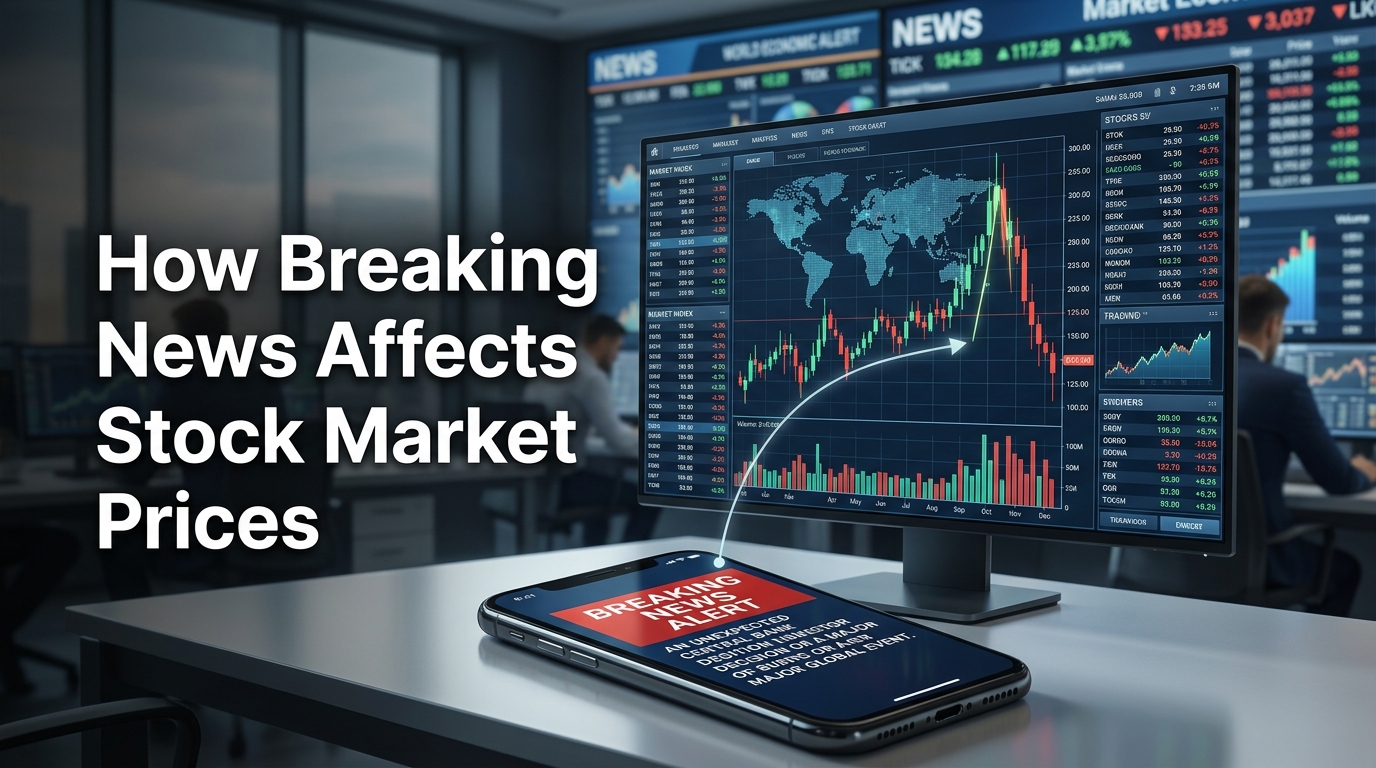
A single headline can move a stock price within seconds. A company announces disappointing earnings, a central bank changes its outlook, or a major policy decision suddenly breaks and investors start reassessing what that news could mean for the future.
But there’s an important detail behind these fast price movements: markets don’t react simply because news is “good” or “bad.” They react when new information changes what investors expected.
That distinction explains why a company can report higher profits and still see its stock fall, while another company can report a loss and watch its shares climb. The real question is whether the news is better or worse than what the market had already anticipated.
Why Breaking News Moves Stock Prices
A stock price represents more than what a company is worth today. Investors are constantly making judgments about its future earnings, growth, costs, and risks.
When new information arrives, those expectations can change almost immediately.
Consider a company that announces 15% profit growth. On its own, that sounds positive. But if analysts and investors were expecting 25% growth, the announcement could disappoint the market and send the shares lower.
The opposite can happen too. A company might report a loss, but if investors expected an even larger loss and management provides a stronger outlook, the stock could rise.
In other words, stock prices respond to surprises, not headlines in isolation.
Three factors are especially important:
- Expected profits: News can change expectations about future revenue, costs, margins, or growth.
- Interest rates: Changes in inflation or monetary policy can affect the value investors place on future earnings.
- Risk: Lawsuits, regulatory problems, geopolitical events, or other uncertainties can change how much risk investors associate with an investment.
This is why the same type of announcement can produce very different reactions depending on the circumstances.
What Does “Priced In” Actually Mean?
You’ll often hear financial commentators say that something has already been “priced in.”
It doesn’t mean investors know exactly what will happen. Rather, the market has already incorporated some expectation of that event into the current price.
Suppose investors strongly expect a company to announce a major product launch. If the announcement arrives exactly as anticipated, the stock may barely move. The information wasn’t necessarily unimportant—it simply wasn’t very surprising.
Things become different when the details don’t match expectations.
Investors may compare the actual announcement with analyst forecasts, previous company guidance, or assumptions that had been reflected in the share price. Even small differences can matter when expectations are high.
That’s why reading only the headline can be misleading. The details underneath it often explain the market reaction.
Not Every News Event Affects the Same Stocks
Breaking news can affect a single company, an entire industry, or the broader market.
An earnings announcement is usually company-specific, but it can also provide clues about competitors. If a major retailer reports weak consumer spending, investors may start wondering whether other retailers are facing the same problem.
The same idea applies to suppliers and customers. A major contract cancellation, for example, could affect not only the company losing the contract but also businesses that depend on that company’s spending.
Other events have a much wider reach.
Interest-rate decisions, inflation reports, employment figures, trade policies, and geopolitical developments can influence companies across multiple sectors because they change the broader economic environment.
A useful way to think about it is this: the wider the financial consequences of the news, the wider its potential market impact.
How Economic News Moves the Market
Economic reports can create surprisingly large market reactions because investors use them to estimate where the economy and interest rates might be heading.
Take inflation.
If inflation comes in higher than expected, investors may increase their expectations for tighter monetary policy. Higher interest rates can affect borrowing costs and the value placed on future corporate earnings.
Employment data can create a different kind of dilemma. Strong hiring may suggest that consumers and businesses remain healthy, which can support economic growth. At the same time, strong employment and wage growth may make investors worry that inflation will remain elevated and interest rates will stay higher for longer.
So even a seemingly positive economic report can produce a negative stock-market reaction.
The context matters.
A strong jobs report during recession fears might reassure investors. The same report during an inflation scare could create concern about interest rates.
Market Sentiment Can Make the Reaction Bigger
Numbers and financial forecasts aren’t the whole story. Human behavior matters too.
When prices begin moving quickly after breaking news, investors can react to what other investors are doing. Some may sell because they’re worried about further losses. Others may buy because they fear missing an opportunity.
That can create a feedback loop where the initial reaction becomes larger.
Behavioral biases can play a role here. Investors may follow the crowd, focus too heavily on the latest event, or pay more attention to information that confirms what they already believe.
Social media can make this effect even faster.
A rumor or incomplete claim can spread across social platforms long before investors have checked the original source. The result can be a sharp price movement based on information that later turns out to be inaccurate.
A screenshot of an alleged company announcement isn’t the same thing as an official filing or company release.
That distinction becomes especially important when markets are moving quickly.
Social Media Has Changed the Speed of Market Reactions
Investors today can receive financial information almost instantly through news alerts, social platforms, company announcements, regulatory filings, and professional market feeds.
Speed is useful, but it creates a problem: information can travel faster than verification.
The European Central Bank has warned that social media can accelerate rumors and disinformation, potentially encouraging herding behavior in financial markets.
The hacked Associated Press account in April 2013 provides a striking example. A false report claiming that explosions had occurred at the White House briefly pushed the Dow Jones Industrial Average down by about 143.5 points. The S&P 500’s market value temporarily fell by an estimated $136.5 billion before the market recovered as the false information was identified.
The episode shows how quickly markets can react when investors believe information is genuine—even when it isn’t.
Where Algorithms Enter the Picture
Humans aren’t the only ones reacting to breaking news.
Financial markets rely heavily on automated systems that can process information and execute trades much faster than a person can read an article.
Algorithmic trading uses programmed rules to make or execute trading decisions. High-frequency trading is a particularly fast form of automated trading. AI-based news analysis is slightly different: it can use natural-language processing to interpret earnings releases, news articles, financial statements, and other text.
These systems can contribute to very fast price discovery.
Research from the Federal Reserve found that news analytics accelerated stock-price and trading-volume responses to news articles, while also reducing liquidity around news events.
That speed has advantages, but it also introduces risks. If automated systems interpret information incorrectly or if many systems respond to the same signal at nearly the same time—the resulting market movement can become more intense.
Volume, Volatility, and Liquidity Are Different Things
When breaking news hits, you’ll often hear about trading volume and volatility. They’re related, but they describe different things.
Trading volume refers to how many shares are being traded.
Volatility describes how significantly and frequently prices are moving.
Liquidity refers to how easily shares can be bought or sold without substantially affecting the price.
A sudden news event can increase volume while also making prices more volatile. At the same time, liquidity may become thinner as market participants become less willing to trade at previous prices.
The bid-ask spread. The difference between the best available buying and selling prices—can also widen when uncertainty increases.
High volume doesn’t necessarily mean investors agree about where a stock should go. It can simply indicate that many investors are reassessing their positions at the same time.
Why Stock Prices Sometimes Reverse After Breaking News
A stock can drop sharply after a headline and then recover. It can also jump and later give back much of its gain.
That doesn’t automatically mean the first reaction was irrational.
Investors may initially react to a headline before reading the full announcement. Management might provide additional information during an earnings call. A rumor could be corrected. Traders may close leveraged positions or cover short positions. Once more information becomes available, investors can reassess the situation.
The market may also realize that the news doesn’t have as much impact on long-term earnings as initially thought.
This is one reason a dramatic first move doesn’t necessarily tell you where a stock will finish the day or where it will trade weeks later.
Real Examples of Breaking News Moving Markets
Recent events show how different types of news can affect markets in very different ways.
In January 2025, concerns surrounding Chinese AI startup DeepSeek triggered a major selloff in AI-related stocks. Nvidia fell nearly 17% in one session, wiping out approximately $593 billion in market capitalization according to Reuters data. The reaction spread beyond Nvidia as investors questioned assumptions about AI infrastructure spending.
In April 2025, an announcement about a U.S. tariff pause produced an enormous positive market reaction. The S&P 500 gained 9.52%, while the Nasdaq Composite rose 12.16% and the Dow gained 7.87%.
The lesson isn’t that tariff announcements always make stocks rise or that AI news always causes technology stocks to fall. These events mattered because they changed investors’ expectations about risk and future economic conditions.
Why Investors Should Be Careful With Breaking News
Fast-moving markets can make immediate trading feel tempting.
There’s a practical problem, though: by the time a retail investor sees a headline on their phone, professional traders and automated systems may already have reacted.
The situation can be even more difficult outside normal trading hours. The SEC warns that extended-hours trading can involve lower liquidity, greater volatility, wider spreads, and fragmented prices. News announcements can cause significant price changes during these periods.
A market order also doesn’t guarantee the price you see when you decide to trade. In a rapidly moving market, the eventual execution price can be quite different.
That doesn’t mean investors should ignore financial news. It means the first headline shouldn’t automatically become a trading decision.
A Better Way to Read Market-Moving News
When a major headline appears, a few basic questions can help separate information from noise:
- Is the information verified? Look for the original company release, regulatory filing, government report, or official announcement.
- Is it actually new? Check whether investors already knew or expected the information.
- What was the surprise? Compare the announcement with forecasts and previous guidance.
- Does it change the company’s fundamentals? Consider revenue, costs, cash flow, financing, or risk.
- How broad is the impact? Is it limited to one company, or could it affect competitors, a sector, or the wider economy?
- What is still uncertain? Separate confirmed facts from speculation.
This approach won’t predict every market move. Nothing can do that consistently. It does, however, provide a much better framework than judging a headline simply as positive or negative.
AI Is Making News Analysis Even Faster
The next stage of market reaction is likely to involve even faster analysis.
AI systems can process earnings calls, financial disclosures, news reports, and social-media content at a scale that’s difficult for individual investors to match. That can help identify relevant information quickly, but it also creates new risks.
If many financial systems rely on similar models or datasets, they could potentially reach similar conclusions and react in similar ways. The Financial Stability Board has highlighted concerns that widespread use of large language models could increase correlations in financial markets.
There are other challenges too, including manipulated information, inaccurate AI interpretations, hallucinations, and synchronized trading.
The faster information travels, the more valuable reliable verification becomes.
The Real Reason News Moves Markets
Breaking news doesn’t have a fixed effect on stock prices.
A headline becomes market-moving when it changes expectations about something investors care about—future earnings, interest rates, risk, demand, costs, or the wider economic environment.
That’s why the same type of news can produce completely different reactions at different times. A strong jobs report might reassure investors during a recession scare but raise concerns about interest rates when inflation is the bigger problem.
For anyone trying to understand market movements, the most useful question isn’t simply, “Was the news good or bad?”
It’s “What did this news change about what investors expected?”
That question gets much closer to explaining why prices move and why sometimes the biggest reaction comes from news that seemed, at first glance, relatively ordinary.