
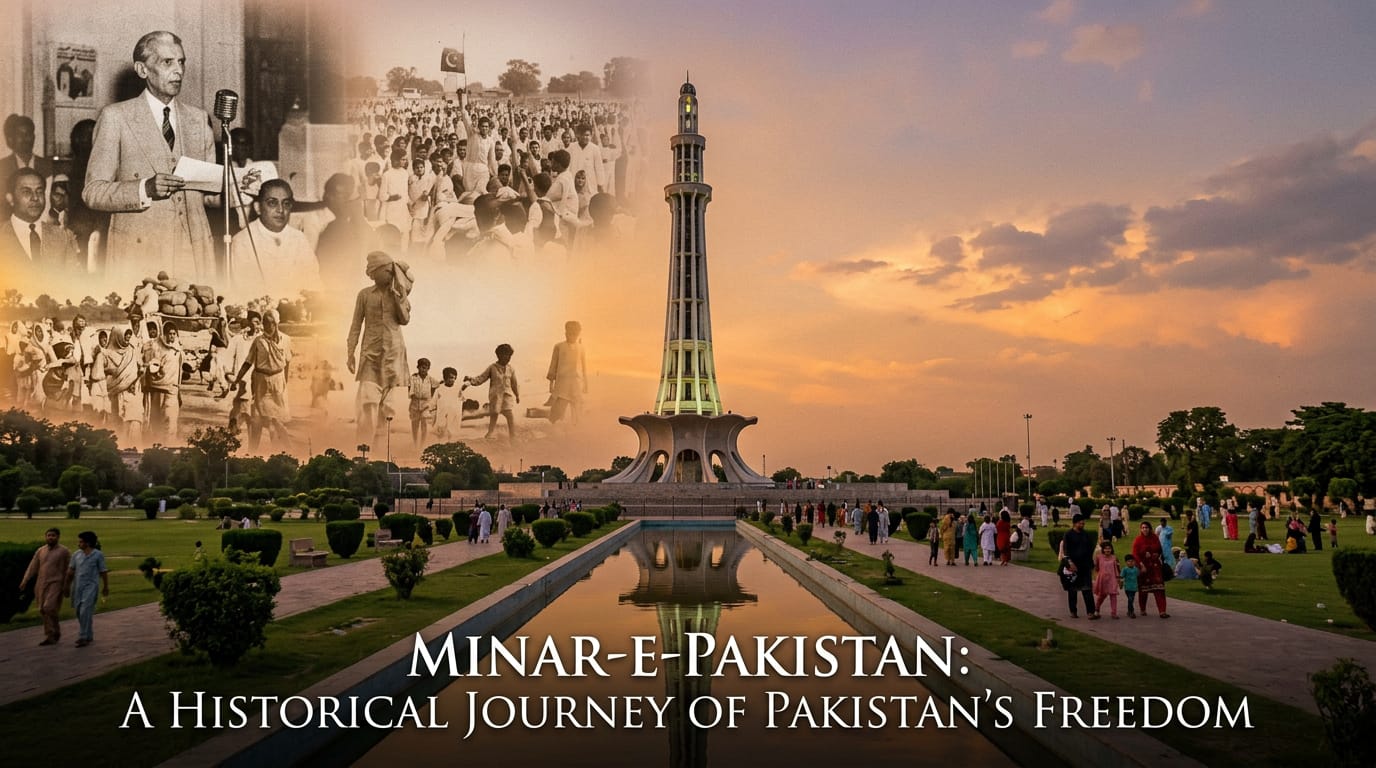

Minar-e-Pakistan: A Historical Journey of Pakistan’s Freedom
Introduction
Minar-e-Pakistan is one of the most important national monuments in Pakistan. It stands proudly in the city of Lahore and reminds us of the long struggle for freedom. This beautiful tower marks the place where a historic decision was made that eventually led to the creation of Pakistan.
In this article, we will take a simple and easy journey through the history of Minar-e-Pakistan and understand why it is so special.
The Historical Background
Before Pakistan came into existence, Muslims of the subcontinent were living under British rule. During this time, they faced many political, social, and economic challenges. They wanted a separate homeland where they could live freely according to their beliefs.
On 23 March 1940, an important event took place at this very spot. The All-India Muslim League held a large gathering in Lahore. Thousands of people attended this meeting, and a resolution was passed that later became famous as the Lahore Resolution.
This resolution demanded a separate homeland for Muslims, which later became Pakistan in 1947.
Role of Great Leaders
The success of this movement was not possible without strong leadership. Muhammad Ali Jinnah, also known as Quaid-e-Azam, played a key role. He guided the Muslims and united them for a common cause.
Another important leader was Allama Iqbal, who had earlier presented the idea of a separate Muslim state. His vision inspired many people and laid the foundation for the Pakistan Movement.
These leaders, along with many others, worked tirelessly to achieve independence.
Construction of Minar-e-Pakistan
After the creation of Pakistan, the government decided to build a monument to remember the historic Lahore Resolution. The construction of Minar-e-Pakistan started in 1960 and was completed in 1968.
The monument was designed by a Turkish architect named Nasreddin Murat-Khan. It is about 70 meters tall and combines both Islamic and modern architectural styles.
The base of the tower is shaped like a flower, representing growth and hope. As the tower rises, it becomes more modern in design, symbolizing progress and a bright future.
Design and Symbolism
Minar-e-Pakistan is not just a tower—it is full of meaning. Every part of its design tells a story:
The base shows the early struggles of Muslims
The middle portion represents unity and strength
The top symbolizes success and independence
The monument is surrounded by the beautiful Greater Iqbal Park, which is a popular place for families and visitors.
The walls of the monument have inscriptions of important speeches and verses in Urdu, Bengali, and English. These include words of Quaid-e-Azam and other leaders.
Importance of Minar-e-Pakistan Today
Today, Minar-e-Pakistan is a symbol of national pride. People from all over the country visit this place to remember the sacrifices made by their ancestors.
Every year on 23 March, Pakistan celebrates Pakistan Day. Special ceremonies are held at Minar-e-Pakistan to honor the historic Lahore Resolution.
Students, tourists, and families visit the monument to learn about the history of Pakistan and to feel connected to their roots.
A Place of Unity
Minar-e-Pakistan reminds us that unity is the key to success. The Muslims of the subcontinent came together despite many differences and achieved their goal.
This monument teaches us that with strong determination and leadership, any dream can become reality.
Conclusion
Minar-e-Pakistan is more than just a structure—it is a symbol of hope, struggle, and freedom. It marks the beginning of a journey that led to the creation of Pakistan.
By remembering the history behind this monument, we can better understand the value of independence and the importance of unity. It inspires every Pakistani to work for a better future while honoring the sacrifices of the past.