How AI Is Changing Digital Marketing in 2026: Trends, Tools, and Strategies
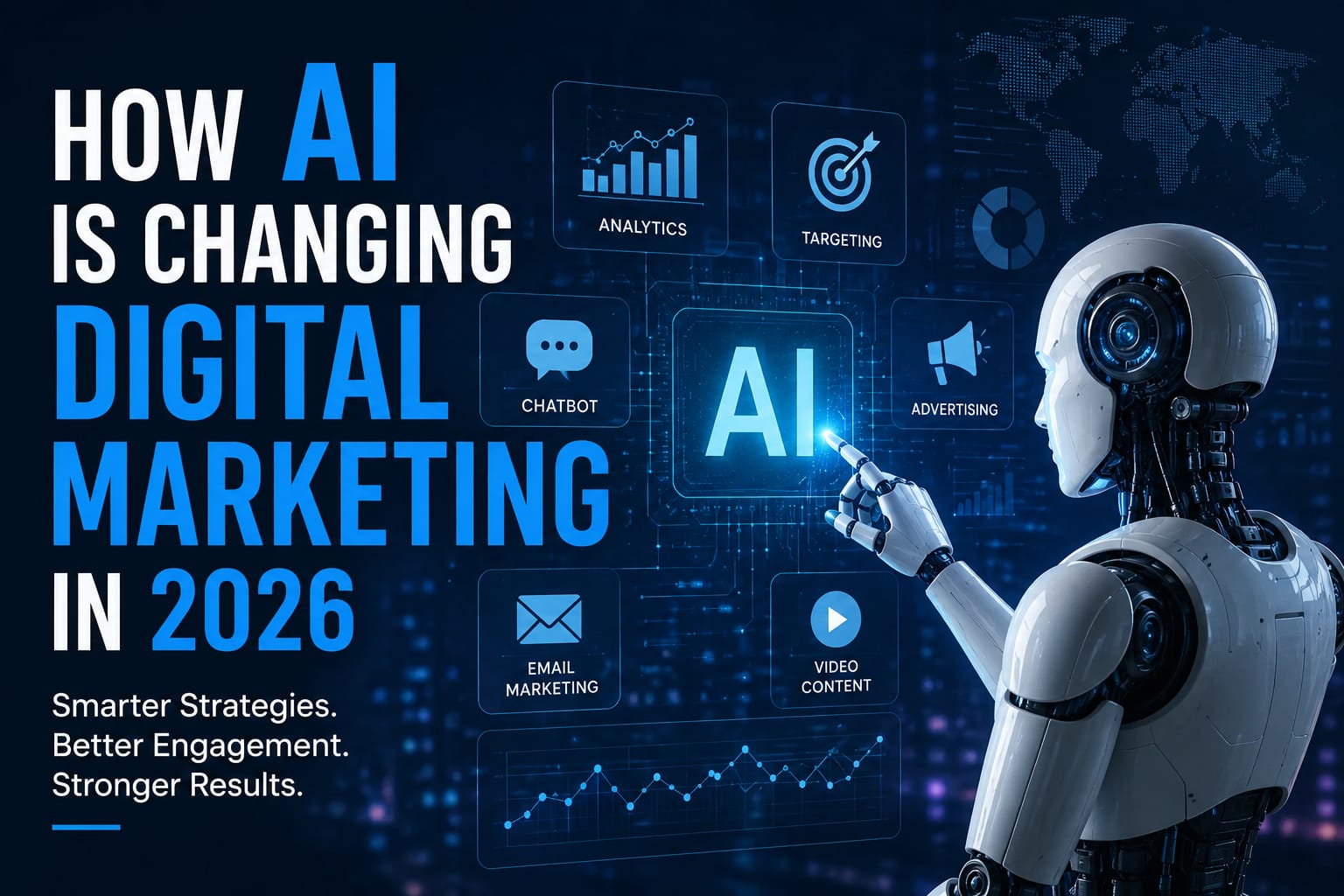
Artificial Intelligence (AI) has become one of the most important technologies shaping digital marketing in 2026. From creating content and analyzing customer behavior to automating advertising campaigns and improving search engine optimization, AI is changing how businesses connect with their audiences.
For marketers, AI is no longer just an experimental technology. It has become a practical tool for saving time, understanding customers, personalizing campaigns, and making better marketing decisions. However, successful digital marketing still depends on human creativity, strategy, accuracy, and trust.
In this article, we explore how AI is changing digital marketing in 2026, the biggest AI marketing trends, its benefits, challenges, and practical ways businesses can use it.
What Is AI in Digital Marketing?
AI in digital marketing refers to the use of artificial intelligence technologies to analyze information, identify patterns, automate repetitive tasks, and assist marketers in creating and optimizing campaigns.
AI can process large amounts of data much faster than humans. This allows marketers to understand customer interests, predict trends, personalize experiences, and make data-driven decisions.
In 2026, AI is being used across many areas of digital marketing, including:
Search engine optimization (SEO)
Content creation
Social media marketing
Email marketing
Paid advertising
Customer support
Data analysis
Marketing automation
Personalization
The biggest change is that AI is moving beyond simple automation and becoming a strategic assistant for marketers.
1. AI Is Transforming Content Creation
One of the most visible effects of AI in digital marketing is content creation.
AI tools can help marketers generate article outlines, headlines, social media ideas, product descriptions, email drafts, and video scripts within seconds. This can significantly reduce the time required to produce marketing materials.
However, AI-generated content should not simply be published without human review. High-quality content still needs accurate information, original insights, useful examples, and a clear understanding of the audience.
A strong approach in 2026 is AI-assisted content creation, where AI helps with research, brainstorming, and organization while humans provide expertise, originality, editing, and final quality control.
2. AI Is Changing SEO
Search engine optimization is another area being strongly influenced by AI.
Traditional SEO focused heavily on keywords, backlinks, and technical optimization. These factors remain important, but modern search increasingly focuses on understanding the meaning and usefulness of content.
AI can help SEO professionals identify relevant topics, discover keyword opportunities, analyze competitors, organize content clusters, and identify gaps in existing articles.
For example, instead of targeting only one keyword such as “digital marketing,” a marketer can create comprehensive content covering related subjects such as AI marketing tools, automation, personalization, customer data, social media, and marketing analytics.
The goal should be to create content that genuinely answers users’ questions rather than writing articles simply to include keywords.
3. Personalized Marketing Is Becoming More Powerful
Consumers increasingly expect brands to provide relevant experiences.
AI makes personalization easier by analyzing customer behavior, preferences, previous interactions, and engagement patterns.
For example, an online store can use AI to recommend products based on a customer’s browsing behavior. An email campaign can show different recommendations to different groups of subscribers.
This type of personalization can make marketing messages more relevant and potentially improve engagement and conversions.
Instead of sending exactly the same message to everyone, businesses can use AI to create more targeted experiences.
4. AI Is Improving Social Media Marketing
Social media marketers have to manage multiple platforms, content formats, posting schedules, comments, and analytics. AI can make many of these tasks easier.
AI-powered tools can assist with:
Generating social media content ideas
Writing captions
Creating content calendars
Analyzing engagement
Identifying audience trends
Repurposing long-form content
Monitoring brand mentions
For example, a long blog post can be transformed into several social media posts, short-video ideas, or newsletter topics.
However, brands still need a distinctive voice. If every social media account publishes generic AI-generated content, audiences may lose interest. Human creativity remains essential for building a recognizable brand.
5. AI Is Changing Paid Advertising
Digital advertising platforms are increasingly using AI and machine learning to optimize campaigns.
AI can analyze signals such as user behavior, audience characteristics, previous interactions, and campaign performance. This can help advertising systems determine where and when advertisements may perform best.
Marketers can also use AI to test different headlines, descriptions, creative concepts, and audience segments.
Instead of manually analyzing every piece of campaign data, marketers can use AI-powered analytics to identify patterns and focus their attention on strategic decisions.
The result can be more efficient campaign management, although businesses should still monitor advertising performance and budgets carefully.
6. AI-Powered Customer Support
Customer experience is an important part of digital marketing, and AI is changing how businesses communicate with customers.
AI-powered chatbots and virtual assistants can answer common questions, provide basic product information, guide users through websites, and assist customers outside normal business hours.
For businesses with large numbers of customer inquiries, this can save considerable time.
However, not every problem should be handled by automation. Complicated or sensitive issues may require human support. The best strategy is often a combination of AI automation and human customer service.
7. AI Is Making Marketing Analytics Smarter
Modern digital marketing generates enormous amounts of data. Understanding that data can be difficult without the right tools.
AI can help marketers identify patterns in website traffic, customer behavior, campaign performance, and conversion data.
Instead of simply looking at what happened, AI-powered analytics can help marketers explore questions such as:
Which campaigns generate the most engagement?
Which audiences are most likely to convert?
Which content attracts visitors?
Where are users leaving the website?
Which marketing channels deserve more attention?
This allows marketers to make decisions based on data rather than assumptions.
8. AI Is Changing Email Marketing
Email marketing is also benefiting from artificial intelligence.
AI can help businesses create subject-line ideas, segment audiences, personalize messages, and identify potentially effective sending times.
For example, customers who frequently purchase a particular type of product can receive content related to their interests rather than receiving generic promotional emails.
Personalization can make email marketing more useful and relevant, but businesses should avoid excessive automation that makes messages feel robotic.
Benefits of AI in Digital Marketing
The growing use of AI offers several advantages for businesses.
Saves Time
AI can automate repetitive marketing tasks, allowing marketers to spend more time on strategy and creative work.
Improves Efficiency
AI can process large amounts of information quickly and help identify useful patterns.
Supports Personalization
Businesses can create more relevant experiences based on customer interests and behavior.
Helps With Content Ideas
AI can assist marketers when they need new topics, headlines, campaigns, or creative concepts.
Supports Data-Driven Decisions
AI-powered analytics can help marketers understand performance and identify areas for improvement.
Challenges of Using AI in Marketing
Despite its advantages, AI also creates challenges.
One major concern is content quality. Automatically generated content can contain errors, outdated information, or repetitive ideas.
Another challenge is privacy. Businesses need to handle customer information responsibly and follow applicable privacy and data-protection requirements.
There is also the risk of over-automation. Marketing is ultimately about people, emotions, trust, and relationships. AI can support these activities, but it cannot completely replace human judgment.
Businesses should therefore treat AI as a tool rather than a complete replacement for marketers.
How Businesses Can Use AI Successfully in 2026
Businesses can start with simple and practical applications rather than trying to automate everything.
First, identify repetitive tasks that consume significant time. Then determine whether AI can safely assist with those tasks.
For example, a business could use AI for content brainstorming, customer-service FAQs, data analysis, or social media planning while keeping human approval for important decisions.
A useful strategy is:
AI for speed + human expertise for quality + data for decisions.
This combination can help businesses take advantage of AI without losing their unique identity.
The Future of AI and Digital Marketing
AI will likely continue to influence digital marketing throughout the coming years. Marketing teams that learn how to work effectively with AI may be able to produce content faster, understand customers better, and respond to changing trends more efficiently.
However, the future of digital marketing will not simply belong to businesses using the most AI tools. It will belong to businesses that use technology intelligently while maintaining originality, credibility, creativity, and strong customer relationships.
Conclusion
AI is changing digital marketing in 2026 by transforming content creation, SEO, social media, advertising, personalization, analytics, email marketing, and customer service.
The technology offers marketers powerful opportunities to automate repetitive work and make smarter decisions. At the same time, businesses need to maintain human oversight, verify information, protect customer data, and focus on creating genuinely useful experiences.
For modern marketers, the most effective approach is not AI versus humans. It is AI working alongside humans. Businesses that combine artificial intelligence with creativity, expertise, and a strong understanding of their audience can build more effective and sustainable digital marketing strategies in 2026.