
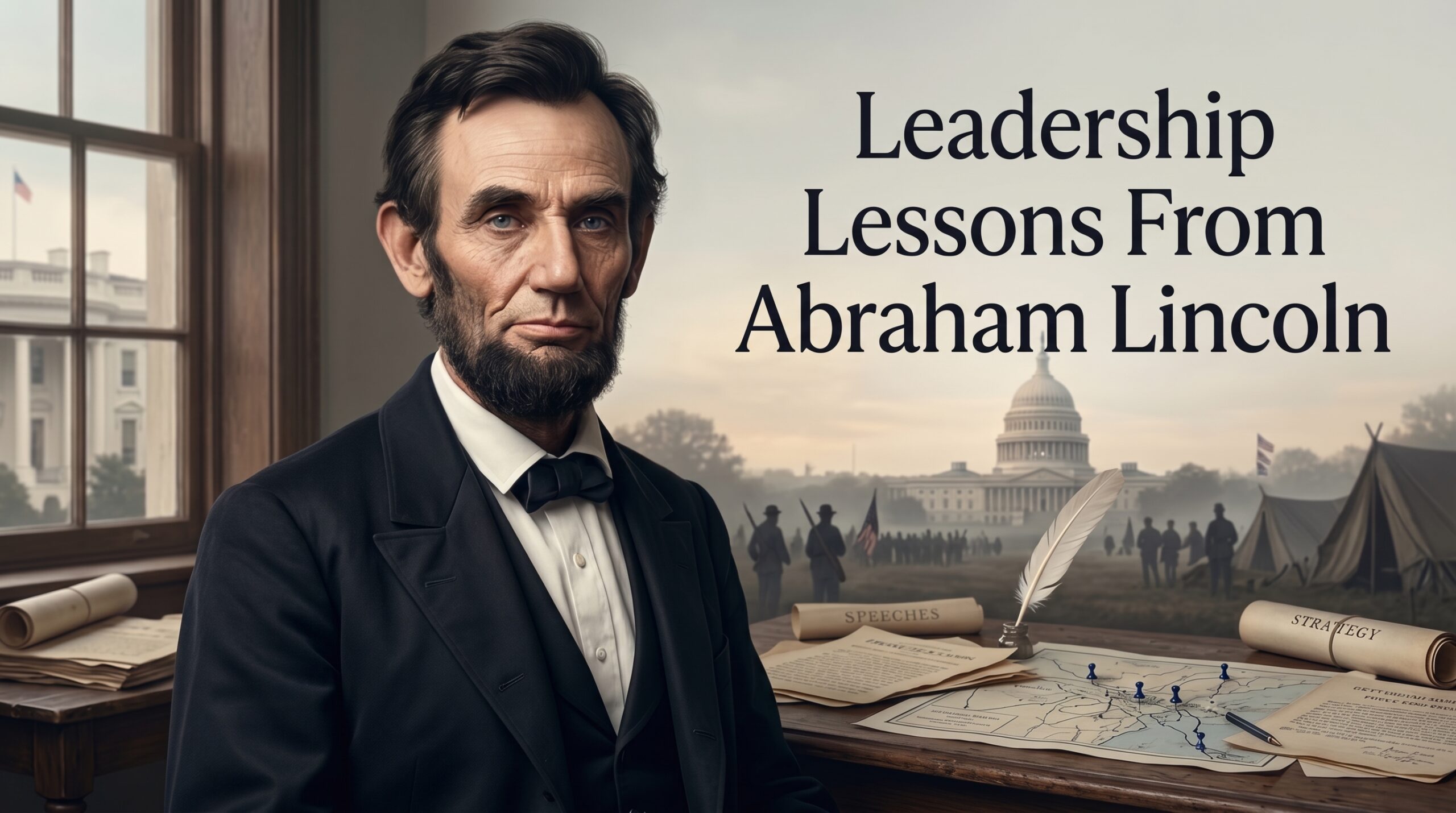
Abraham Lincoln is often remembered as one of America’s greatest presidents, but his leadership was tested under circumstances few leaders have ever faced. When he took office in 1861, the United States was breaking apart, civil war was beginning, and millions of lives were affected by decisions made in Washington.
What makes Lincoln’s leadership worth studying is not that he was perfect. He wasn’t. His views evolved, some of his decisions remain debated, and he operated within the political and racial limitations of nineteenth-century America. His value as a leadership example comes from something more practical: how he made decisions, responded to failure, communicated during uncertainty, and adapted as circumstances changed.
Here are six leadership lessons from Abraham Lincoln that still have relevance today.
1. Lead Decisively During a Crisis
Leadership becomes most difficult when there is no perfect choice.
Lincoln entered the presidency during one of the most serious crises in U.S. history. Several Southern states had seceded, armed conflict was approaching, and Lincoln had little previous military experience. Yet as commander in chief, he had to make decisions that could affect the survival of the Union.
One of his most consequential decisions was the Emancipation Proclamation. Lincoln had drafted a preliminary version in July 1862, but he did not immediately announce it. Secretary of State William Seward advised waiting until the government had a military success so the proclamation would not appear to be an act of desperation. After the Union’s strategic success at Antietam, Lincoln issued the preliminary proclamation in September 1862. It took effect on January 1, 1863.
The lesson is not simply “act quickly.” Good crisis leadership requires knowing when action is possible, what authority supports it, and what consequences may follow.
For modern leaders, this means defining the immediate mission, gathering the right information, considering risks, and then making the decision instead of remaining stuck waiting for perfect certainty.
2. Listen to People Who Disagree With You
A leader does not need to agree with everyone. But a good leader should be willing to hear them.
Lincoln demonstrated this during the preparation of his First Inaugural Address. He shared drafts with people around him, including William Seward, who suggested substantial changes. Seward’s proposed revisions filled six pages. Lincoln accepted some suggestions, rejected others, and adapted part of Seward’s proposed language into the final address.
A similar pattern appeared when Lincoln presented his preliminary Emancipation Proclamation to his Cabinet. Seward recommended delaying its announcement until a military victory. Lincoln followed that advice.
This illustrates an important leadership distinction: listening is not the same as surrendering authority.
Lincoln sought different perspectives while retaining responsibility for the final decision.
Modern leaders can apply the same principle by actively inviting disagreement before making important decisions. Instead of asking only, “Does everyone agree?” they can ask, “What risk are we missing?” or “What would make this plan fail?”
The goal isn’t to create agreement at any cost. It is to make better decisions.
3. Communicate a Clear Vision
During periods of conflict, people need more than instructions. They need to understand why the struggle matters.
Lincoln was particularly powerful at connecting immediate events with larger principles. In his First Inaugural Address, he appealed to Americans not simply as political opponents but as people with a shared national history. Later, in the Gettysburg Address, he connected the Civil War with the principles of equality and democratic government.
His Gettysburg Address was remarkably short. He had been invited to Gettysburg to make “a few appropriate remarks” at the dedication of a military cemetery. Yet the speech became one of the most influential statements of the war’s meaning.
The leadership lesson is simple: people are more likely to support difficult action when they understand its purpose.
This applies far beyond politics. A manager introducing major changes, a teacher motivating students, or a business owner guiding a team through a difficult period all need to explain the bigger picture.
Clear communication does not require complicated language. Often, the strongest message is the one people can remember.
4. Make Room for Empathy
Leadership is not only about strategy and performance. It is also about people.
The Civil War produced enormous loss, and Lincoln regularly encountered the human consequences of that conflict. A particularly well-documented example is his December 1862 letter to Fanny McCullough, whose father had been killed during the war. Lincoln offered personal consolation while acknowledging the pain that the family was experiencing.
This matters because empathy in leadership is not simply about being “nice.” It is about understanding what people are experiencing and responding appropriately.
In modern workplaces, leaders may face layoffs, failed projects, personal emergencies, conflict, or major organizational changes. A purely task-focused response can make people feel ignored or disposable.
An empathetic leader doesn’t necessarily remove the difficult decision. Instead, they acknowledge its human impact.
There is also an important historical caution here. Popular stories sometimes portray Lincoln as universally compassionate, but historians cannot establish a single personality trait from every event in his life. Even the famous letter to Lydia Bixby has an authorship debate. For that reason, documented examples such as the Fanny McCullough letter are stronger evidence than popular anecdotes.
5. Learn From Failure and Adapt
One of Lincoln’s most practical leadership qualities was his willingness to change course.
The Union struggled with military leadership during the early years of the Civil War. Lincoln dealt with commanders including George B. McClellan, Ambrose Burnside, and Joseph Hooker, making changes when military performance failed to meet expectations.
When Lincoln appointed Hooker to command the Army of the Potomac, he did something particularly interesting. His letter openly addressed Hooker’s weaknesses, including his political ambitions and previous criticism of the administration. Yet Lincoln also expressed confidence that Hooker could perform the job.
Lincoln’s approach demonstrates that adaptability isn’t about changing direction randomly. It means holding onto the goal while being willing to change the method.
He also showed an unusual willingness to admit mistakes. In a letter concerning Ulysses S. Grant’s Vicksburg campaign, Lincoln acknowledged that Grant had been right and he had been wrong about a strategic judgment.
That is a powerful lesson for modern leaders.
A failed plan doesn’t necessarily mean the goal was wrong. Sometimes the strategy, structure, timing, or person responsible needs to change.
Instead of protecting your ego, look at the evidence. If something repeatedly isn’t working, change it.
6. Connect Values With Responsibility
Perhaps the most complicated lesson from Lincoln is the relationship between leadership, morality, and responsibility.
Lincoln personally opposed slavery, but his approach to emancipation evolved during the Civil War. In an 1862 letter to newspaper editor Horace Greeley, he stated that his primary objective was saving the Union while also expressing his personal wish that all people could be free.
As the war progressed, emancipation became increasingly connected to Union policy and military strategy. The Emancipation Proclamation transformed the purpose and consequences of the war by declaring enslaved people in areas in rebellion to be free and allowing Black men to join the Union armed forces.
By his Second Inaugural Address in March 1865, Lincoln spoke much more directly about slavery and the moral consequences of the war. He called for a “just, and a lasting peace” and urged reconciliation rather than revenge.
But historical accuracy matters here. Lincoln did not single-handedly end slavery, and the Emancipation Proclamation did not abolish slavery everywhere. The Thirteenth Amendment, ratified after Lincoln’s death, abolished slavery throughout the United States.
The broader leadership lesson is that values become meaningful when leaders accept responsibility for turning them into action.
A leader should be able to explain what principle is at stake, understand the limits of their authority, and recognize the consequences of their decisions.
What Modern Leaders Can Learn From Lincoln

Abraham Lincoln’s leadership wasn’t a formula for avoiding difficult situations. His presidency demonstrates almost the opposite: sometimes leadership means making decisions when every available option carries serious consequences.
His example offers several principles that remain useful today:
- Act decisively during crises, but understand timing and consequences.
- Listen to disagreement without giving up responsibility for the final decision.
- Communicate the purpose behind difficult actions.
- Recognize the emotional and human impact of leadership decisions.
- Change strategies when evidence shows that they aren’t working.
- Connect values with concrete action and accountability.
Perhaps the biggest lesson is that effective leadership is not about appearing certain all the time. Lincoln faced uncertainty, made mistakes, changed his approach, listened to others, and continued moving toward what he believed was the larger national objective.
That makes his leadership more useful to study—not because he was a flawless hero, but because his decisions reveal how leadership actually works when the stakes are high.