
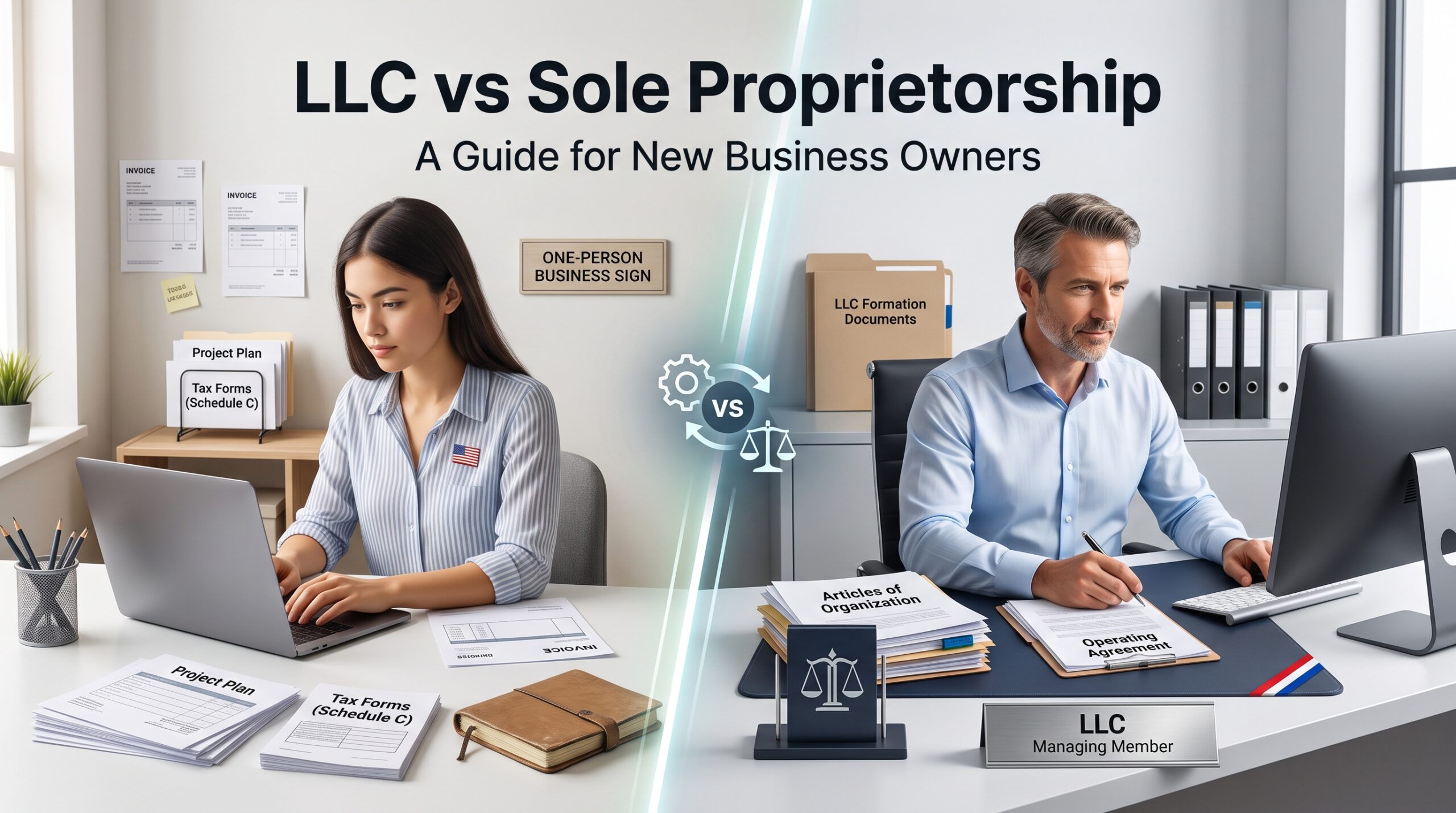
Starting a business in the U.S. comes with a lot of decisions. You need to think about your business name, customers, pricing, marketing, taxes, and—perhaps most importantly—how your business should be structured.
For many first-time business owners, the choice comes down to LLC vs sole proprietorship.
Both can work for a small business, but they are not the same. A sole proprietorship is usually simpler and easier to start, while an LLC (Limited Liability Company) creates a separate legal entity that can generally provide protection between the business and the owner’s personal assets.
The right choice depends on factors such as your business activities, liability risk, state requirements, expected income, and how much paperwork you’re willing to handle.
Let’s break down the difference between an LLC and a sole proprietorship in simple terms.
What Is a Sole Proprietorship?
A sole proprietorship is the simplest type of business structure for a one-person business. If you start doing business on your own without forming an LLC or corporation, you are generally operating as a sole proprietor.
There is usually no separate business entity between you and your business.
For example, imagine you start a freelance graphic design business under your own name. You find clients, complete projects, receive payments, and report the business income on your personal tax return. Unless you form another business entity, you may be operating as a sole proprietor.
One major advantage is simplicity. You generally don’t have to file LLC formation documents just to establish the sole proprietorship.
However, that doesn’t mean there are no requirements. Depending on your location and business activity, you may still need business licenses, permits, sales-tax registration, zoning approval, or a DBA (Doing Business As) registration.
The biggest drawback is personal liability. Because the business and owner are not legally separate, the owner can generally be personally responsible for business debts and obligations.
What Is an LLC?
An LLC, or Limited Liability Company, is a business entity created under state law.
Unlike a sole proprietorship, an LLC creates a legal separation between the business and its owners, who are called members.
An LLC can have one owner, known as a single-member LLC, or multiple owners, known as a multi-member LLC.
To form an LLC, you generally need to:
- Choose a business name that follows state rules
- File formation documents with the appropriate state office
- Pay the required state filing fee
- Designate a registered agent when required
- Meet applicable tax, licensing, and reporting requirements
- Follow ongoing state compliance requirements
The exact process and cost depend on the state where you form and operate the business.
An LLC can also provide flexibility in how the business is managed. Depending on the structure, members can manage the company themselves, or managers can be appointed to run the business.
LLC vs Sole Proprietorship: What’s the Difference?

The biggest difference between an LLC and a sole proprietorship is legal separation.
With a sole proprietorship, you and your business are essentially the same legal entity. With an LLC, the business is generally treated as a separate legal entity under state law.
| Factor | Sole Proprietorship | LLC |
|---|---|---|
| Owners | One | One or more |
| Formation | Usually simple and automatic | Requires state formation filing |
| Personal liability | Generally unlimited | Generally provides liability protection |
| Startup cost | Usually lower | State filing and other fees may apply |
| Ongoing paperwork | Generally less | More compliance requirements |
| Federal tax treatment | Reported on owner’s return | Depends on LLC’s tax classification |
| Ownership changes | Limited | Can generally add members |
| Management | Owner-controlled | Member- or manager-managed |
| Business continuity | Usually tied closely to owner | Can provide more continuity |
| Tax flexibility | Limited | May elect certain tax classifications |
The important point is that an LLC isn’t automatically better for every business. It simply provides a different legal and administrative structure.
LLC vs Sole Proprietorship Taxes
Taxes are one of the areas where new business owners often get confused.
A common misconception is that forming an LLC automatically reduces your taxes. It doesn’t.
Sole Proprietorship Taxes
A sole proprietor generally reports business income and deductible expenses using Schedule C (Form 1040).
Your business revenue minus allowable business expenses generally results in your net business profit or loss. That amount is then included on your individual federal tax return.
If your net earnings from self-employment are $400 or more, you generally use Schedule SE to calculate self-employment tax.
In simple terms, a profitable sole proprietor may have to deal with both:
- Federal income tax
- Self-employment tax
State and local taxes may also apply depending on where the business operates.
Single-Member LLC Taxes
Here’s where things get interesting.
A single-member LLC is generally treated as a disregarded entity by the IRS for federal income-tax purposes unless the owner chooses a different tax classification.
For many one-owner businesses, that means the federal tax reporting can look very similar to a sole proprietorship.
Business income may still be reported on Schedule C, and self-employment tax can still apply.
So, simply changing your business structure from a sole proprietorship to a single-member LLC does not automatically mean you’ll pay less federal tax.
Multi-Member LLC Taxes
A domestic LLC with two or more members is generally treated as a partnership for federal income-tax purposes unless it elects corporate treatment.
The LLC itself generally reports information to the IRS, while profits, losses, deductions, and credits can pass through to the members.
An eligible LLC can also potentially elect S-corporation or C-corporation tax treatment. However, these options involve additional rules and responsibilities and aren’t automatically beneficial for every business.
If you’re considering an S-corporation election because of your income level, it’s worth talking with a qualified tax professional before making the decision.
LLC Liability Protection vs Sole Proprietorship
This is often the biggest reason people consider forming an LLC.
A sole proprietorship doesn’t create a legal wall between the business and the owner. If the business has significant debts or faces certain legal claims, the owner’s personal assets may be exposed.
An LLC generally provides a layer of separation between the business’s obligations and the owner’s personal assets.
For example, if an LLC has a business debt, the debt generally belongs to the LLC rather than automatically becoming the owner’s personal debt.
But there’s an important catch: limited liability doesn’t mean zero liability.
An LLC owner may still be personally responsible in situations such as:
- Personally guaranteeing a business loan
- Committing fraud or other personal wrongdoing
- Certain unpaid employment or payroll taxes
- Mixing personal and business finances
- Failing to maintain the business as a separate entity
That’s why forming an LLC isn’t the only step you should take to protect your business.
Business insurance, written contracts, proper bookkeeping, separate finances, and following state requirements are also important.
How Much Does an LLC Cost?
There’s no single nationwide price for forming an LLC.
LLC formation costs vary by state.
You may have to pay a state filing fee when creating the LLC. Depending on the state, you could also have annual or biennial reports, franchise taxes, annual fees, registered-agent expenses, publication requirements, or other costs.
For example, California generally charges a filing fee for Articles of Organization and also has an annual LLC tax. New York has its own filing and publication requirements, while Delaware has a different fee and annual tax structure.
That’s why it’s better to check your state’s official government website before budgeting for an LLC.
And remember, a sole proprietorship isn’t necessarily completely free either. You may still have expenses for licenses, permits, DBA registration, insurance, tax preparation, and other business requirements.
Which Is Better for a New Business Owner?
There isn’t one answer that applies to everyone.
A sole proprietorship may make sense for someone testing a simple business idea, especially when the business has relatively low liability exposure and the owner wants minimal administrative work.
For example, a freelancer, writer, tutor, or independent consultant may initially prefer the simplicity of a sole proprietorship.
An LLC may be worth considering when the business has greater liability exposure, signs significant contracts, works with employees, handles inventory, owns equipment, or plans to add business partners.
An LLC can also make sense for someone who wants a more formal business structure and a legal separation between the business and personal assets.
The important thing is to look at your actual situation rather than choosing a structure simply because another business owner uses it.
Common LLC and Sole Proprietorship Misconceptions
There are several myths that can make this decision more confusing than it needs to be.
“An LLC completely protects my personal assets.”
Not necessarily.
An LLC generally provides liability protection, but there are exceptions. Personal guarantees, personal wrongdoing, certain tax obligations, and failure to maintain proper separation can still create personal liability.
“An LLC always saves taxes.”
No.
A single-member LLC often has the same default federal income-tax treatment as a sole proprietorship. Tax benefits depend on the business and the tax classification chosen.
“A sole proprietorship is completely free.”
Not always.
You may not have an entity formation fee, but licenses, permits, DBA registration, insurance, and other business expenses can still apply.
“Every LLC needs an EIN.”
Not necessarily.
Certain single-member LLCs that are disregarded for federal income-tax purposes may not need a separate EIN in some circumstances. However, an EIN may be required for employees, certain tax filings, or other situations. Banks and state agencies may also have their own requirements.
“An LLC and an S corporation are the same thing.”
They’re not.
An LLC is a state-law business entity. S corporation is a federal tax classification that eligible businesses can elect.
An LLC can potentially elect S-corporation tax treatment, but forming an LLC does not automatically make the business an S corporation.
What Should You Consider Before Choosing?
Before deciding between an LLC and a sole proprietorship, ask yourself a few practical questions.
What type of business am I starting?
A freelance writing business has a different risk profile from a construction company or a business selling physical products.
How much liability risk does my business have?
Think about customer injuries, property damage, contracts, employees, products, vehicles, and professional services.
Am I the only owner?
A sole proprietorship is designed around one owner. If you plan to have co-owners, an LLC may provide a more practical ownership structure.
What state am I operating in?
State rules can significantly affect LLC costs, taxes, reports, licenses, and other requirements.
How much paperwork can I handle?
A sole proprietorship generally has fewer entity-level compliance requirements. An LLC can involve additional filings, fees, records, and deadlines.
Do I expect the business to grow?
If you’re planning to add partners, employees, investors, or significant contracts, think beyond your current situation.
LLC or Sole Proprietorship: A Simple Way to Think About It
If you’re still confused, think about the decision this way:
A sole proprietorship prioritizes simplicity.
An LLC adds legal structure and generally provides liability separation, but comes with additional costs and compliance responsibilities.
For some new entrepreneurs, starting as a sole proprietor may be practical while testing an idea. For others, the liability protection and formal structure of an LLC may be important from the beginning.
Your business doesn’t have to follow someone else’s path.
Before making the decision, check your state’s current requirements and consider speaking with a qualified attorney or tax professional if your business has significant liability, multiple owners, employees, or complex tax considerations.
The goal isn’t simply to choose the cheapest or most popular business structure. It’s to choose a structure that fits how your business operates today and where you expect it to go next.
Final Thoughts
The LLC vs sole proprietorship decision is one of the first major choices many new U.S. business owners face.
A sole proprietorship can be simple, inexpensive to establish, and easy to manage. An LLC requires more setup and ongoing compliance, but generally creates a separate legal entity and can provide important liability protection.
Neither structure is automatically right for every entrepreneur.
Look at your business type, liability exposure, state rules, expected income, future plans, and administrative needs. Once you understand those factors, the decision becomes much easier to evaluate.