
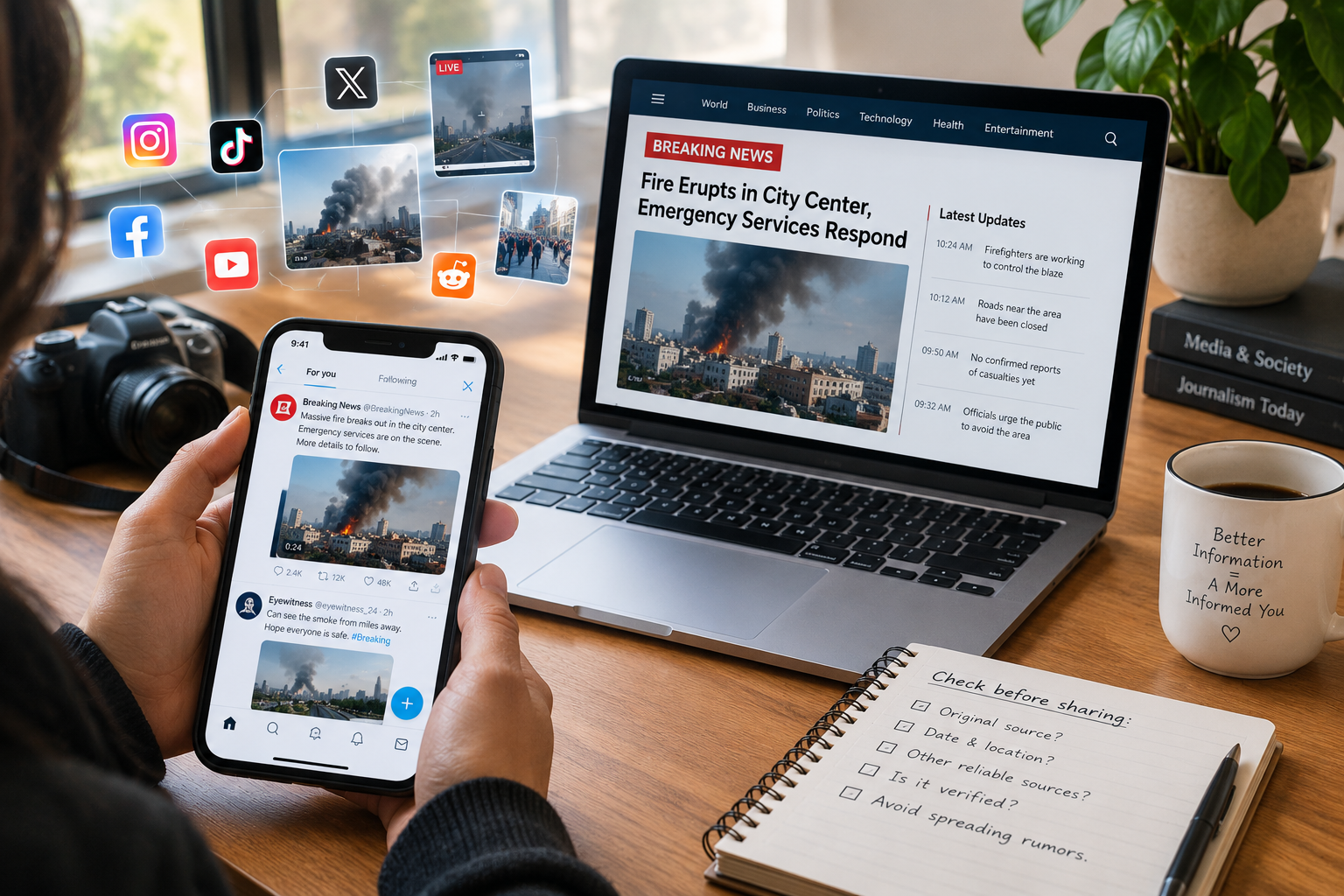
A breaking-news story used to follow a fairly predictable path. Something happened, a reporter gathered the facts, the newsroom checked the information, and the story appeared on television, radio, a newspaper, or a news website.
Today, that process can happen in a completely different order.
A shaky phone video, a post from someone near the scene, a livestream, or a message shared in a local community can become the first sign that something important has happened. Within minutes, the story can spread across X, Facebook, Instagram, TikTok, YouTube, Reddit, and messaging platforms.
Social media has made breaking news faster and more interactive. But it has also created a new challenge: the information spreading fastest is not always the information that has been verified.
From News Bulletins to Social Feeds
Before social media, audiences generally depended on news organizations to discover and report major events. Today, people can encounter breaking news directly through their social feeds.
A person at the scene can record a video and publish it before a journalist arrives. An emergency agency can post an update instantly. A local resident can share what they are seeing with thousands of people.
This has changed the traditional news cycle. Social platforms now work as both newsgathering tools and distribution channels. Journalists monitor them for eyewitnesses, images, public reactions, official statements, and clues about developing stories.
The shift is especially important because audiences increasingly discover news through social and video platforms rather than traditional publisher websites or scheduled broadcasts. Reuters Institute’s Digital News Report 2025 describes this broader movement toward a more fragmented, platform-based news environment.
Why Breaking News Travels So Quickly
There are several reasons social media has accelerated breaking-news coverage.
Real-Time Updates
News organizations, reporters, witnesses, emergency services, and public officials can publish updates as events happen. There is no need to wait for the next newspaper edition or television bulletin.
Eyewitness Videos
People who happen to be near an event can record photos and videos immediately. Their footage may reach journalists before professional crews arrive.
Livestreaming
Platforms such as YouTube, Instagram, Facebook, TikTok, and X allow people to livestream developing events, giving audiences an immediate view of what is happening.
Global Reach
A local event can become international news within minutes when people begin reposting it or major accounts and news organizations pick it up.
Continuous Coverage
Instead of publishing one finished report and waiting for the next edition, newsrooms can update stories throughout the day with new information, corrections, videos, and context.
However, there is an important difference between discovering information quickly and confirming it quickly. A viral video may show that something happened without proving where, when, or why it happened.
The Rise of Citizen Journalism
Social media has also changed who can participate in news coverage.
Ordinary people can now document wildfires, floods, protests, accidents, storms, conflicts, and other major events. They may not consider themselves journalists, but their photos and videos can become important pieces of a breaking-news story.
This can be extremely valuable.
An eyewitness may capture something professional journalists cannot reach in time. Several people recording the same event from different angles can provide additional evidence. Local residents can also help identify streets, landmarks, weather conditions, or other details that outsiders may not immediately recognize.
But citizen journalism has limitations.
A person can accurately record a scene while misunderstanding what caused it. A genuine video can also become misleading if someone adds the wrong location, date, or caption.
That is why professional journalists cannot simply assume that an authentic-looking social-media post is automatically accurate.
How Journalists Verify Social-Media Content
For a newsroom, a social-media post is usually a lead rather than a confirmed report.
One useful verification framework focuses on four basic questions:
- Provenance: Is this the original photo or video?
- Source: Who created or uploaded it?
- Date: When was it actually recorded?
- Location: Where was it recorded?
Journalists may contact the original uploader, examine account history, perform reverse-image searches, compare landmarks with maps or satellite imagery, check weather conditions, and compare the material with independent eyewitnesses and official information.
Metadata can sometimes provide additional clues, although it may be missing or altered after content has been shared.
This verification process matters because old photos and videos are frequently presented as if they were connected to a current event. A real piece of footage can therefore become misinformation simply because it has been given the wrong context.
The Online News Association also emphasizes verification, attribution, transparency, permission, credit, and safety when journalists use user-generated content.
The Problem With Viral Breaking News
One of the biggest challenges created by social media is the speed at which misinformation can spread.
Breaking news is particularly vulnerable because people want answers while reliable information is still limited. Dramatic images and emotional claims can attract attention, while old footage, edited clips, fabricated screenshots, impersonation accounts, and AI-generated images can make false information appear convincing.
Sometimes misinformation does not even begin with someone deliberately trying to deceive others.
A person may find an old video, assume it is related to a current event, add an urgent caption, and share it. Other users then repost it without checking. Within minutes, the original mistake can become difficult to trace.
This is why one simple rule is worth remembering:
Viral does not mean verified.
A post’s number of views, likes, or shares tells you how widely it has circulated—not whether its claims are true.
Speed vs. Accuracy
Breaking-news journalists face constant pressure to publish quickly. Being among the first outlets to report a major event can attract significant attention.
But publishing too early can create serious problems.
A newsroom could report an incorrect casualty number, identify the wrong person, misinterpret a video, or repeat an unconfirmed explanation. Even when a correction is published later, the original claim may already have reached thousands or millions of people.
Responsible newsrooms therefore try to balance speed with accuracy. They can clearly distinguish confirmed facts from witness claims, explain what remains unknown, attribute information to its source, update stories as new evidence appears, and make significant corrections visible.
The goal is not necessarily to wait until every detail is known.
It is to be honest about how much is actually known at that moment.
How Algorithms Shape Breaking News
There is another factor that influences what people see: algorithms.
Social platforms do not show every user exactly the same posts in the same order. Recommendation systems use signals such as user behavior, predicted relevance, relationships, recency, watch time, and engagement to determine which content receives attention.
This can have a major effect during breaking news.
A dramatic video may suddenly reach millions of people. Emotional commentary may appear alongside professional reporting. A controversial claim may attract more attention than a carefully written explanation.
As a result, people may encounter a highly emotional or incomplete version of a story before they ever see the verified context.
This does not mean algorithms are the only factor determining what becomes popular. Newsroom decisions, audience interests, geography, language, influential accounts, and the importance of an event also matter.
Still, algorithms influence which version of a developing story people encounter first.
Audiences Are Part of the News Cycle
Social media has transformed audiences from passive news consumers into active participants.
People can record events, share local knowledge, ask questions, point out mistakes, provide additional footage, and help journalists locate witnesses.
That participation can improve coverage.
But it can also create problems such as rumor cascades, harassment, amateur investigations, misidentification, and the unnecessary spread of disturbing images.
Ethical concerns become especially important when breaking news involves violence, deaths, disasters, or vulnerable people.
Sharing graphic footage without context can cause unnecessary harm. Identifying victims or suspects before official confirmation can affect families and investigations. Even contacting an eyewitness can create risks if that person is in a dangerous situation.
For journalists, being able to publish something does not automatically mean it should be published.
How to Spot Reliable Breaking News on Social Media
Readers also have a role to play.
Before sharing a breaking-news post, take a moment to check:
- Find the original source. Avoid relying only on screenshots and reposts.
- Check who posted it. Look for credible journalists, news organizations, or official agencies.
- Look for independent confirmation. See whether other reliable sources are reporting the same basic facts.
- Check the date and location. Old footage can easily be presented as current.
- Look for missing context. A short video may not show what happened before or after it.
- Be careful with emotional claims. Shocking posts deserve extra scrutiny.
- Follow corrections and updates. Breaking stories change as more information becomes available.
These simple habits can make a significant difference, especially when a story is developing quickly.
The Future of Breaking News
Social media is unlikely to replace traditional journalism. Instead, the two increasingly operate alongside each other.
Newsrooms use social platforms to discover stories, find eyewitnesses, distribute updates, and communicate with audiences. At the same time, professional journalism provides something social feeds often cannot: verification, context, accountability, and a structured effort to establish what is actually known.
The most important change may therefore not be that social media made news faster.
It made verification more important.
A modern breaking-news story can begin with a single phone recording and reach millions of people within minutes. But turning that first piece of information into reliable journalism still requires careful checking, responsible reporting, and transparency about uncertainty.
Social media has fundamentally changed breaking-news coverage. It has given ordinary people a direct role in documenting events, allowed journalists to report in real time, and made information available to global audiences almost instantly.
At the same time, the same speed that makes social media useful can make misinformation difficult to contain.
The future of breaking news is therefore not simply about who can post first. It is about who can verify quickly, explain clearly, provide context, and correct responsibly.
For readers, the lesson is just as important: before believing or sharing a breaking-news post, pause and check the source, timing, location, and independent confirmation. In an environment where almost anyone can publish instantly, knowing how to verify information has become an essential part of being an informed news consumer.